About Junonia stemosa Grishin, 2020
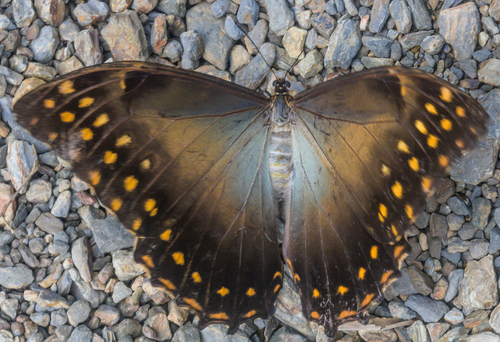
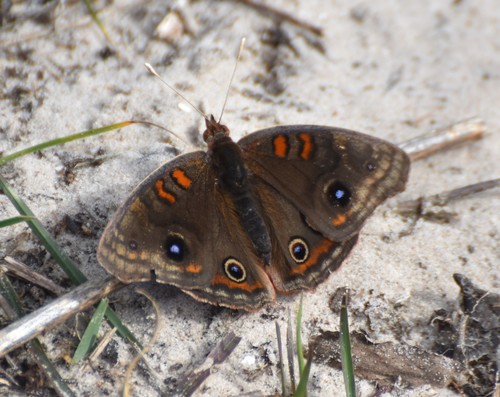
Morphology Adult Junonia stemosa closely resembles the common buckeye (Junonia coenia) but can be distinguished by its more angular and slightly elongated forewing apex. The dorsal surface is generally darker than that of J. coenia, with reduced orange patterning and a subtle purplish or bluish sheen visible in some individuals. The ventral wings are usually brown or gray with clearly defined eyespots that help deter predators. These traits, together with genomic differences, confirm that J. stemosa is a distinct species separate from both J. coenia and Junonia nigrosuffusa. Eggs of J. stemosa are pale green and spherical, with fine vertical ridges. Larvae hatch after approximately three days and go through five instars. Early instars have long black setae extending from dark scoli, while later instars develop white or tan spotting and increasingly broken stripe patterns along the body. Head coloration also changes noticeably: third-instar larvae develop a pale triangular marking on the face, and by the fifth instar the upper head capsule becomes reddish with a contrasting pale area above the mouth that creates a face-like appearance. Larvae show considerable color variability, ranging from brown to darker patterned forms, and the final instar is often heavily marked with white bumps and branched scoli. Pupae are mottled and cryptic, and blend in against the host plant. Some freshly emerged adults have a purple sheen on the forewings, a trait that is occasionally observed in wild individuals. Distribution and habitat Junonia stemosa is endemic to southern Texas, particularly along the Gulf Coast and on barrier islands such as South Padre Island. The species lives in open coastal prairies, sandy flats, and meadow systems dominated by its larval host plant, Stemodia tomentosa, a perennial herb that grows well in dry, sandy soils near the coast. Adult J. stemosa often fly in the same areas as two other buckeye species, Junonia coenia and Junonia nigrosuffusa, but maintain distinct ecological boundaries due to differences in host-plant use and adult physical traits. The geographic distribution of J. stemosa appears to be shaped by the patchy distribution of S. tomentosa. This host specialization restricts the butterfly to coastal regions of southern Texas, where populations can be locally abundant in areas where the host plant is dominant. Ecology and life history Larvae of Junonia stemosa feed exclusively on Stemodia tomentosa. This association is ecologically significant because the dense hairy covering of S. tomentosa prevents Junonia coenia caterpillars from feeding on it; J. coenia caterpillars normally refuse the plant and die if they cannot access other food. In contrast, J. stemosa larvae readily feed on S. tomentosa, an adaptation that is thought to have contributed to the species' divergence from J. coenia. Adult J. stemosa have visually based mating preferences, with dark-winged individuals preferentially courting mates with similar patterning. Seasonal differences in host-plant persistence may also reinforce species boundaries: S. tomentosa persists year-round, allowing J. stemosa populations to remain stable through winter, whereas Agalinis, the primary host of J. coenia, dies back seasonally, reducing local J. coenia populations. Although hybridization has been recorded across North American Junonia, genomic data confirm that J. stemosa maintains genetic integrity as a distinct species.