About Junonia iphita (Cramer, 1782)
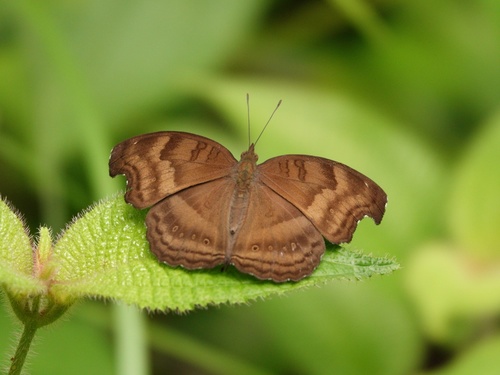
This species, Junonia iphita (Cramer, 1782), has the following physical description: For both sexes, the upperside is brown with varying depth of color. On the forewing, the cell contains one pair of subbasal and one pair of apical transverse sinuous fasciae, with the outermost fascia defining the discocellulars. Beyond this, there is a short, broad, dark, oblique fascia extending to vein 4, which has a diffuse inner margin and a sinuous but sharply defined outer margin. Below vein 4 lies a faint, sinuous, transverse fascia, which is followed by a discal blackish fascia that is very broad and diffuse below the costa. This discal fascia is bordered by a row of faint ocelli, and a postdiscal and a subterminal fascia of similar appearance follow the outline of the termen. On the hindwing, there is a slender blackish loop near the apex of the cellular area. A broad short discal fascia, which is diffuse inwardly and well-defined outwardly, continues from the matching fascia on the forewing. There is a series of postdiscal, somewhat ochraceous ocelli with black pupils that have minute white centers. Broad postdiscal and subterminal lines match those found on the forewing. The underside is brown, marked with very broad darker brown transverse fasciae; the spaces between these markings are irrorated (sprinkled) with purplish silvery scales. On the forewing's basal half, there are two sinuous fasciae, followed by a discal fascia that is very broad at the costal margin and narrows toward the dorsum. A row of obscure ocelli runs along the outer border of this discal fascia. After this fascia comes a zigzag dark line, then sinuous subterminal and terminal lines. The apex and tornal area are suffused with purplish silvery scales. On the hindwing, there are two irregular, very broad, dark brown, curved short fasciae near the base. There is also a straight, transverse, prominent, narrow ochreous-brown discal band that is defined outwardly by a black line. A transverse postdiscal dark brown fascia, which is widest in the middle, bears a curved row of ochreous-brown, white-centered ocelli on its outer edge. This is followed by a zigzag dark line that continues the matching line from the forewing. A somewhat diffuse dark subterminal fascia and a dark terminal line complete the markings on the hindwing. The antennae, head, thorax, and abdomen are dark brown. Larvae of Junonia iphita feed on a variety of plant species belonging to the family Acanthaceae, including Hygrophila costata, Justicia micrantha, Justicia procumbens, Justicia sphaerosperma, Lepidagathis formosensis, Strobilanthes callosus, Strobilanthes formosanus, Barleria cristata, Dipteracanthus prostratus, Hygrophila auriculata, Ruellia elegans, Ruellia simplex, Ruellia tuberosa, Strobilanthes, Achimenes grandiflora, and Strobilanthes ciliata.