About Junonia evarete Cramer, 1782
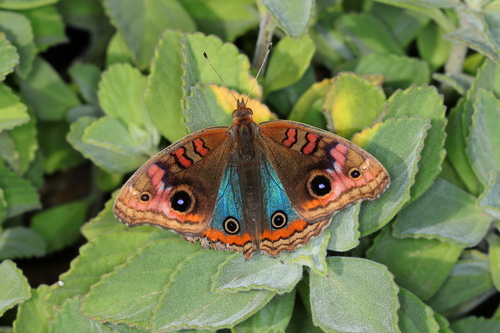
Junonia evarete, commonly called the tropical buckeye or South American tropical buckeye, is a South American nymphalid butterfly in the Nymphalidae family. This species has characteristic wing eye spots, and its wingspan ranges between 4.5 and 6.5 cm, which equals 1.8 to 2.6 inches. It is easily confused with Junonia genoveva, the mangrove buckeye. Both the common names mangrove buckeye and tropical buckeye have been confused, and the two species have sometimes been misidentified in past literature. Their high number of variations, subspecies, and seasonal forms makes them difficult to identify and tell apart. Phylogenetic studies have confirmed that evarete and genoveva are separate species, but current evidence shows that more subspecies and potentially additional species within this group are still waiting to be described. In ecological terms, the tropical buckeye occurs across tropical and subtropical South America. It inhabits a wide range of areas including tropical plains, shrub and scrub habitats, islands, primary and secondary forests, and both urbanized and suburbanized environments. It has a very fast, low flight pattern, and prefers open, sunny fields. Adult tropical buckeyes feed on nectar. Males typically remain on vegetation or the ground waiting for receptive females, and will often wait this way for an entire day. Females lay their eggs singly on the undersides of host plant leaves, favoring mock vervain (Glandularia carolinensis), Cayenne snakeweed (Stachytarpheta cayennensis), and white mangrove (Laguncularia racemosa) as host plants.