About Junonia atlites (Linnaeus, 1763)
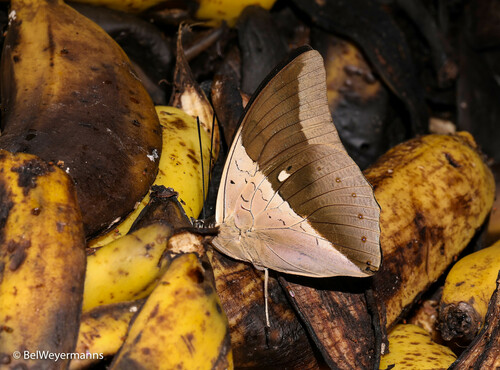
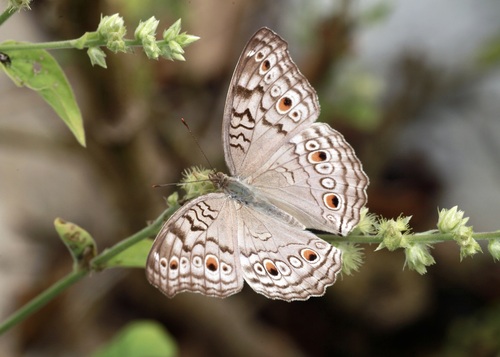
Junonia atlites (Linnaeus, 1763) is described in detail below. For the upperside of both sexes, the base color is pale lavender brown, with the apical half of the wings being paler. On the forewing, the cell contains three short, transverse, sinuous black bands; the outermost of these bands defines the discocellulars. A similar short, somewhat broader band sits beyond the apex of the cell. There are also two transverse discal dusky black fasciae: the inner fascia is highly sinuous, outward angulate above vein 4, while the outer fascia is straighter and somewhat lunular, bordered by a series of whitish ovals with dusky or black centers. The black-centered spots within the ovals in interspaces 2, 5, and 6 are margined posteriorly with rich ocherous yellow. Beyond this series of ovals lies a lunular, narrow, transverse dark band, which is followed by sinuous subterminal and terminal broad dark lines. The apex of the forewing is slightly fuliginous. On the hindwing, a short slender black loop runs from veins 6 to 4 at the apex of the cell area. Two sinuous transverse dark discal fasciae extend as continuations of the matching fasciae on the forewing, followed by a series of dark-centered ovals in interspaces 2–6; the ovals in interspaces 2, 5, and 6 have their dark centers broadly bordered with ochreous yellow on the inner side. Postdiscal, subterminal, and terminal dark lunular lines match those on the forewing. The underside of the wings is lilacine white, with the same markings found on the upperside, but the markings here are very delicate, slender, and somewhat obsolescent. In dry-season forms of males, the rows of oval ocelli are only indicated by yellow-centered ovals. The most prominent marking on the underside is the inner discal fascia that crosses both wings; this fascia is much less sinuous than it is on the upperside and is not angulated on the forewing. In females, all markings are heavier and more distinct, and the space between the various transverse fasciae is tinged with ocherous. J. atlites is distributed across Bangladesh, India, southern China, Cambodia, Indochina, the Malay Peninsula, western and central Indonesia, and the Philippines. The larvae of J. atlites feed on Oryza, Pseuderanthemum, Strobilanthes, Asteracantha longifolia, Alternanthera philoxeroides, Barleria, Hygrophila lancea, and Hygrophila salicifolia.