About Juniperus virginiana L.
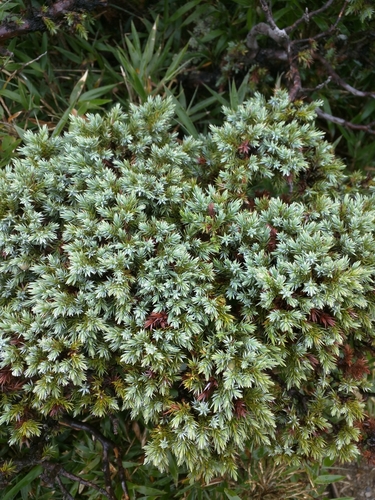
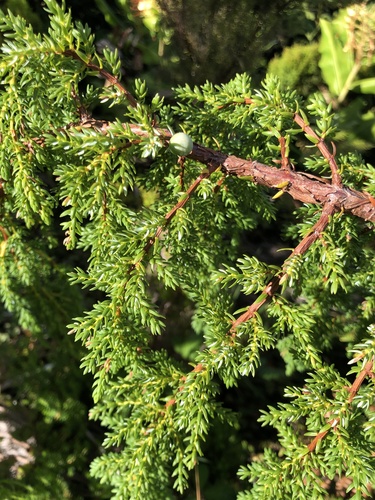
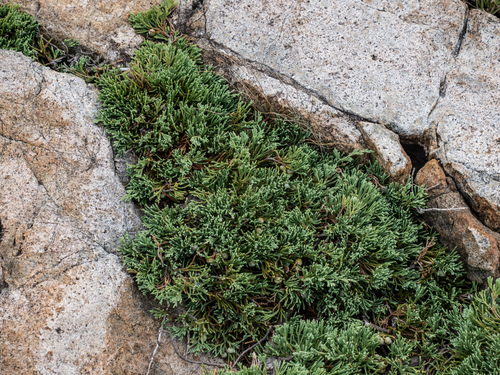
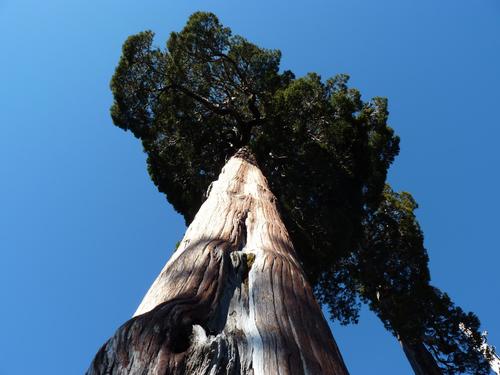
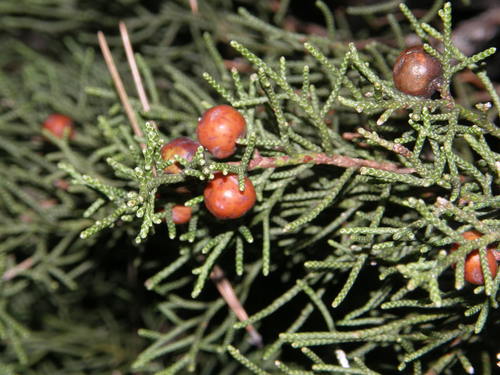
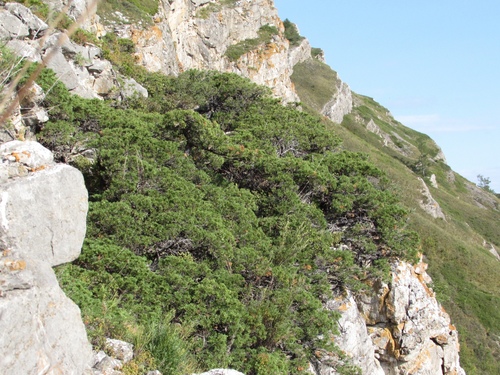
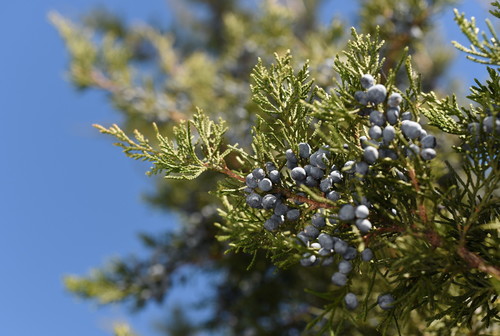
Juniperus virginiana L. is a dense, slow-growing coniferous evergreen tree. It typically has a conical or subcylindrical crown, and may only grow as a bush in poor soil. Ordinarily it reaches 5–20 metres (16–66 feet) tall, with a short trunk 30–100 centimetres (12–39 inches) in diameter; rarely it can grow to 27 m (89 ft) tall and 170 cm (67 in) in diameter. The oldest reported individual, from West Virginia, was 940 years old. Its bark is reddish-brown, fibrous, and peels off in narrow strips. It produces two types of leaves: sharp, spreading needle-like juvenile leaves 5–10 millimetres (3⁄16–3⁄8 in) long, and tightly pressed scale-like adult leaves 2–4 mm (1⁄16–3⁄16 in) long. Leaves are arranged in opposite decussate pairs, or occasionally in whorls of three. Juvenile leaves grow on young plants up to 3 years old, and as scattered shoots on adult trees, usually in shaded areas. Its seed cones are 3–7 mm (1⁄8–1⁄4 in) long, berry-like, and dark purple-blue with a white wax coating that gives them an overall sky-blue color (though the wax often rubs off). Each cone holds 1 to 3 (rarely up to 4) seeds, and reaches maturity 6–8 months after pollination. These berry-like cones are an important winter food source for many birds, which disperse the wingless seeds. Its pollen cones are 2–3 mm (1⁄16–1⁄8 in) long and 1.5 mm (1⁄16 in) broad, and shed pollen in late winter or early spring. Most trees are dioecious, meaning they produce pollen cones and seed cones on separate individuals, but some are monoecious, with both cone types on the same tree. There are two intergrading varieties that meet where their ranges overlap. Juniperus virginiana var. virginiana, called eastern juniper or redcedar, is found in eastern North America, from Maine west to southern Ontario and South Dakota, south to northernmost Florida, and southwest into the post oak savannah of east-central Texas. This variety has larger cones, 4–7 mm (3⁄16–1⁄4 in), scale leaves with acute tips, and red-brown bark. Juniperus virginiana var. silicicola (Small) E.Murray (syn. Sabina silicicola Small, Juniperus silicicola (Small) L.H.Bailey) is known as southern or sand juniper or redcedar. Its variety name means "flint-dweller", from Latin silex and -cola. Its habitat is along the Atlantic and Gulf coasts from the extreme southeastern corner of Virginia, south to central Florida and west to southeast Texas. This variety has smaller cones, 3–4 mm (1⁄8–3⁄16 in), scale leaves with blunt tips, and orange-brown bark. Some authors treat it as a distinct species, while others classify it at the lower rank of variety. Eastern red cedar is a pioneer species, one of the first trees to recolonize disturbed sites. It is unusually long-lived for a pioneer species, with the potential to live over 900 years. It is commonly found in prairies, oak barrens, old pastures, or limestone hills, often along highways and near recent construction sites. It acts as an alternate host for cedar–apple rust, an economically significant fungal disease that affects apples, so some management strategies recommend removing J. virginiana near apple orchards. Eastern red cedar grows in a wide range of climatic and soil conditions. The tree is extremely tolerant of drought thanks to its extensive, fibrous root system and reduced leaf area. It can grow anywhere from dry, rocky, low-nutrient soils to rich alluvial soils with abundant moisture. However, eastern red cedar is almost never dominant on these rich mesic sites, due to intense competition from faster growing, more shade-tolerant hardwood trees. Outside of its native range it is considered an invasive species, and it can grow aggressively even within its native range. It is fire-intolerant, and was historically controlled by periodic wildfires. Low branches near the ground burn and act as a ladder that allows fire to engulf the entire tree. Low-severity fires characteristic of prairies kill these trees but allow grasses to recover quickly, which historically kept tree populations in check. With the urbanization of prairies, fires have been stopped by roads, plowed fields, and other fire breaks, which allows J. virginiana and other trees to invade these areas. Left unmanaged, these trees damage grassland ecosystems, and they are actively eliminated by cutting and prescribed burning. The trees also burn very easily, and dense populations were blamed for the rapid spread of wildfires in drought-stricken Oklahoma and Texas in 2005 and 2006. On the Great Plains, expanding red cedar populations are altering the plains ecosystem: a majority of the region's bird species are not present in areas where red cedar land cover exceeds 10 percent, and most small mammal species are absent where land cover exceeds 30 percent. Unlike the grasses it competes with, eastern juniper benefits from increased atmospheric CO2 levels. Many grasses are C4 plants that concentrate CO2 in their bundle sheaths to increase the efficiency of RuBisCO, the enzyme responsible for photosynthesis, while junipers are C3 plants that rely on natural environmental CO2 concentrations (and may benefit from higher concentrations), although they are generally less efficient at fixing CO2. Alterations to prairie ecosystems caused by J. virginiana include outcompeting forage species in pastureland. Its low branches and wide base occupy a large portion of land area, and its thick foliage blocks most sunlight, so few plants can survive under its canopy. Fallen juniper needles raise soil pH, making the soil alkaline, which binds nutrients such as phosphorus and makes it harder for other plants to absorb them. However, studies have found that Juniperus virginiana forests that replace grasslands have changes in soil nitrogen levels ranging from a statistically insignificant decrease to a significant increase. J. virginiana forests have higher overall nitrogen use efficiency (NUE), despite the common grassland species Andropogon gerardi having a much higher photosynthetic nitrogen use efficiency (PNUE). These forests store much greater amounts of carbon in both biomass and soil, with most of the additional carbon stored aboveground. There is no significant difference in soil microbial activity between the replaced grasslands and J. virginiana forests. Cedar waxwings are particularly fond of juniper berries. It takes about 12 minutes for the seeds to pass through the birds' guts, and seeds consumed by this bird have germination rates roughly three times higher than seeds not eaten by birds. Many other birds, including turkeys and bluebirds, along with many mammals such as rabbits, foxes, raccoons, and coyotes also consume the berries. Virginia juniper's compact, evergreen foliage makes it a good site for bird nests, and a good winter shelter for birds and mammals. The fragrant, finely grained, soft, brittle, very lightweight, pinkish to brownish red heartwood is very durable, even when in contact with soil. Because of its resistance to decay, the wood is often used for fence posts. Moths avoid the aromatic wood, so it is in demand as lining for clothes chests and closets, which are often called "cedar closets" and "cedar chests". If correctly prepared, excellent English longbows, flatbows, and Native American sinew-backed bows can be made from it. It is marketed as "eastern redcedar" and "aromatic cedar". The best portions of the heartwood are one of the few woods suitable for making pencils, however the supply had diminished so much by the 1940s that incense-cedar wood largely replaced it for this purpose. Some commercially available cedar oil is produced by steam distillation from wood shavings. It contains a wide variety of terpenes. The three major components, alpha-cedrene, thujopsene and cedrol, make up more than 60% of the essential oil. The fruits also yield an essential oil which contains mostly D-Limonene. Oil derived from foliage and twigs has two main constituents: safrole and limonene. One minor compound found in the oil is podophyllotoxin, a non-alkaloid toxin lignan. Historically, Native American tribes used juniper wood poles to mark agreed-upon tribal hunting territories. French traders named Baton Rouge, Louisiana, which means "red stick", after the reddish color of these poles. Some nations still use the wood ceremonially. The Cahokia Woodhenge series of timber circles built by pre-Columbian Mississippian culture in western Illinois were constructed from massive eastern juniper logs. One iteration of this circle, Woodhenge III, thought to have been built around 1000 AD, had 48 posts forming a circle 410 feet (120 m) in diameter, with a 49th pole in the center. Among many Native American cultures, smoke from burning eastern juniper is believed to expel evil spirits before a ceremony, such as a healing ceremony. During the Dust Bowl drought of the 1930s, the Prairie States Forest Project encouraged farmers to plant eastern juniper shelterbelts (wind breaks) throughout the U.S. Great Plains. The trees thrive in adverse conditions: tolerant of both drought and cold, they grow well in rocky, sandy, and clayey soils. Competition between individual trees is minimal, so they can be closely planted in rows, and still grow to full height in this arrangement, creating a solid windbreak in a short time. A number of cultivars have been selected for horticulture, including 'Canaertii' (narrow conical; female), 'Corcorcor' (dense, erect crown; female), 'Goldspire' (narrow conical with yellow foliage), and 'Kobold' (dwarf). Some cultivars previously listed under this species, notably 'Skyrocket', are actually cultivars of J. scopulorum. In the Ozarks of Arkansas, Missouri, and Oklahoma, eastern juniper is commonly used as a Christmas tree. It is the most widely used wood for making recorder blocks. It has a number of properties that make it uniquely suitable for this use, including good moisture absorption, low expansion when wet (so it does not crack the recorder head), and mild antiseptic properties. Eastern red cedar is considered effective as a shelter-belt tree and for erosion control. As a conifer, it has dense evergreen foliage that makes it an ideal windbreak. The tree's extensive root system allows it to survive drought, and helps retain surrounding topsoil during dry, windy conditions.