About Juniperus occidentalis var. australis (Vasek) P.Lebreton & N.H.Holmgren
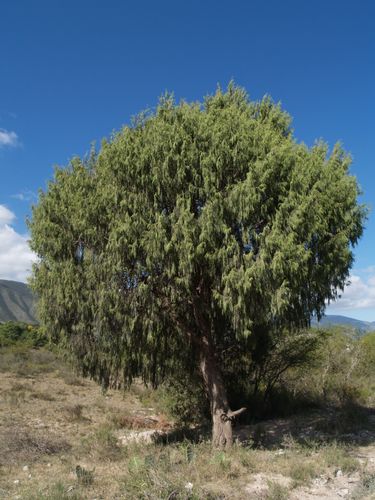
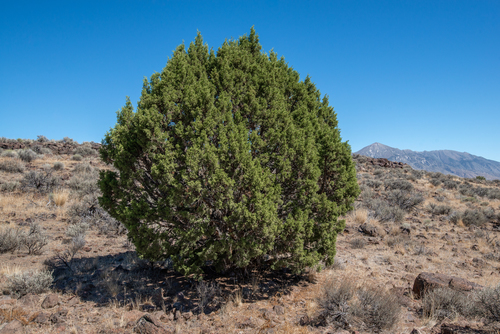
Juniperus occidentalis, which this variety belongs to, grows as a shrub or small tree reaching 4 to 15 meters (13 to 49 feet) tall. Exceptionally tall specimens over 26 to 28 meters (85 to 92 feet) occur in the John Day area of Oregon. Among junipers, its shoots have a moderate thickness, with a diameter of 1 to 1.6 millimeters (1/32 to 1/16 inch). Only young seedlings produce juvenile leaves, which are needle-like and 5 to 10 mm (3/16 to 13/32 inch) long. Adult leaves are arranged in opposite decussate pairs or whorls of three; they are scale-like, 1 to 2 mm long (reaching 5 mm on lead shoots) and 1 to 1.5 mm broad.
The seed cones of this plant are berry-like, 5 to 10 mm in diameter, blue-brown with a whitish waxy bloom, and mature in around 18 months. Male cones are 2 to 4 mm long and shed pollen in early spring. Roughly half of all individuals are monoecious, bearing both sexes on the same plant, and half are dioecious, producing cones of only one sex. Each cone contains 1 to 3 seeds, most of which germinate in spring. In Oregon, where most of the population lives, seeds germinate in April and new foliage emerges in June. Seed dispersal is carried out by water runoff, gravity, and animals.
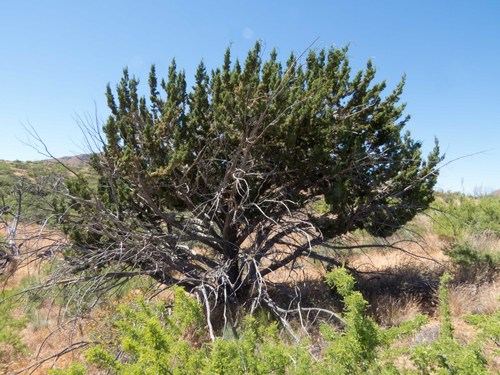
Juniperus occidentalis grows in the Western United States, specifically in southeast Washington, eastern and central Oregon, southwest Idaho, northeastern California and extreme northwest Nevada. It occurs north of 40° 30' N latitude and east of the Cascade Range. It most often grows on dry, rocky sites where it faces less competition from larger species like ponderosa pine and coast Douglas-fir. Annual precipitation in its habitat can be as low as 20 centimeters (7 7/8 inch). In very exposed high-altitude locations, it may develop a krummholz growth habit, staying low to the ground even when mature, while retaining a wide trunk. Hybrids with Juniperus osteosperma are occasionally found. In the John Day area of Oregon, it competes for sunlight alongside ponderosa pines at the bottom of some deep side canyons, but it more commonly grows to 4 to 15 m (13 to 49 ft) with a bushier habit on open, barren ground.
Ecology: The berry-like cones are an important food source for several bird species, including the American robin, Clark's nutcracker, phainopepla, and cedar waxwing. These birds digest the fleshy cone scales and disperse the plant's seeds in their droppings. The plants often develop galls caused by the juniper tip midge, Oligotrophus betheli. These galls are violet-purple when young, fading to brown, 1 to 2 cm (3/8 to 13/16 inch) in diameter, and covered in dense modified spreading scale-leaves 6 to 10 mm (1/4 to 3/8 inch) long and 2 to 3 mm broad at the base.
Fire ecology: Over the past two decades, western juniper has expanded throughout sagebrush steppe ecosystems in the western United States. This vegetation change is linked to decreased fire frequency, livestock overgrazing, and climate change that has produced a wetter, milder climate. Dated fire scar data shows this expansion began between 1875 and 1885, reaching a peak growth rate between approximately 1905 and 1924. Since the 1990s, the use of prescribed fires to control the species' expansion has increased, and this increased use has shown positive effects on plant communities.
Uses: Like other junipers, Juniperus occidentalis produces cone crops commonly called juniper berries. While original European gin was flavored with berries from Juniperus communis, several distilleries (particularly in Bend, Oregon) use local western juniper berries to flavor their gin. It is not a common lumber source, but Oregon State University has sponsored research into using western juniper for commercial applications such as sign posts and guard rails. Western juniper lumber is known for its durability and high compression strength.