About Juniperus flaccida Schltdl.
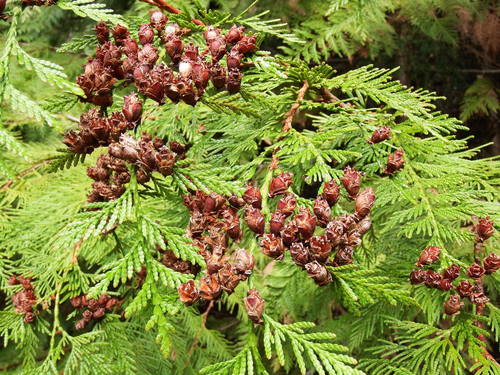
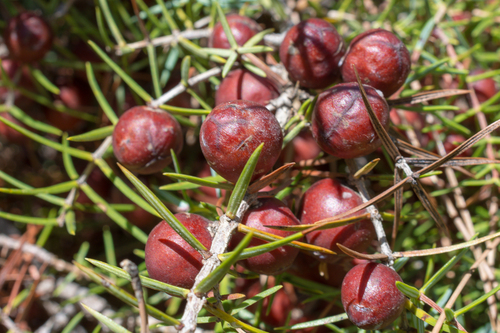
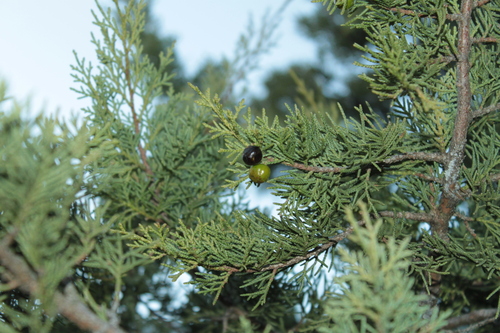
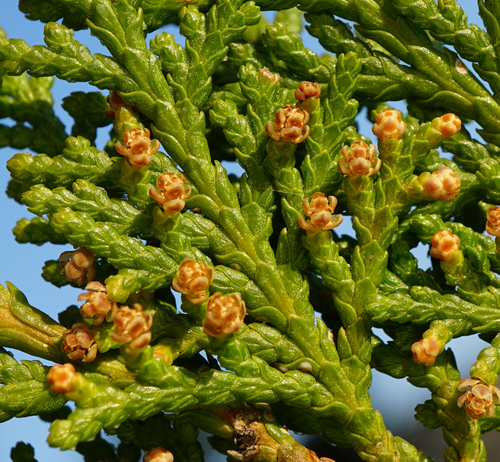
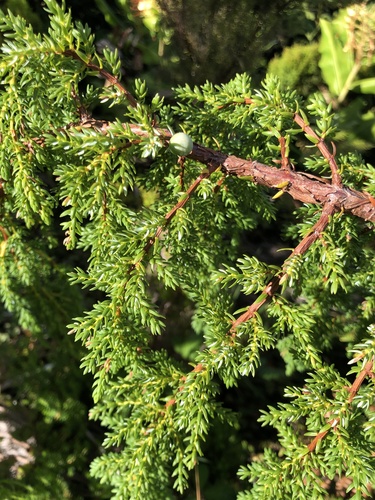
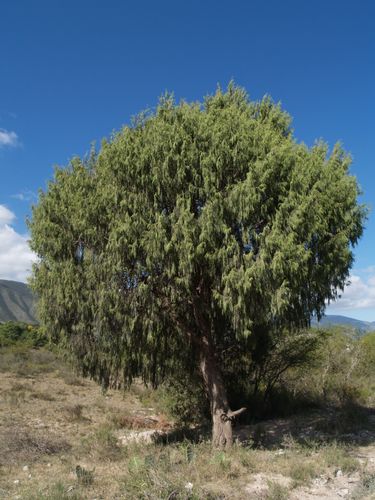
Juniperus flaccida Schltdl., commonly called drooping juniper, weeping juniper, Mexican juniper, or tláscal, is a large shrub or small tree. It typically grows 5–10 metres (16–33 feet) tall, and rarely reaches up to 15 metres. It is native to central and northern Mexico, occurring from Oaxaca northward, and the extreme southwest of Texas, United States, specifically in Brewster County. It grows at moderate altitudes between 800–2,600 metres (2,600–8,500 feet) on dry soils. Its bark is brown, with stringy vertical fissuring. Its shoots are strongly pendulous, 1–1.2 mm in diameter, and are often borne in flattened sprays — this is a trait not commonly seen in most other juniper species. Its leaves are arranged in opposite decussate pairs. Adult leaves are scale-like, 2–4 mm long (reaching up to 7 mm on lead shoots) and 1–1.5 mm broad. Juvenile leaves, which only grow on young seedlings, are needle-like, 5–10 mm long. Its seed cones are berry-like, 8–20 mm in diameter; they start green and mature to brown, and contain 6–12 seeds, more seeds per cone than any other juniper species. These cones are mature after approximately 18 months of growth. Its male cones are 3–5 mm long, and shed their pollen in spring. The species is largely dioecious, with each individual tree producing cones of only one sex. Three varieties are recognized by some authorities, though not all experts accept them as distinct: Juniperus flaccida var. flaccida, which occurs throughout the full range of the species, has cones 9–15 mm in diameter with inconspicuous scale margins; Juniperus flaccida var. martinezii, which is restricted to a small area in Jalisco, has cones 6–8 mm in diameter with inconspicuous scale margins; and Juniperus flaccida var. poblana, which occurs throughout the southern two thirds of the species' range, has cones 12–20 mm in diameter with conspicuous scale margins.