About Juniperus bermudiana L.
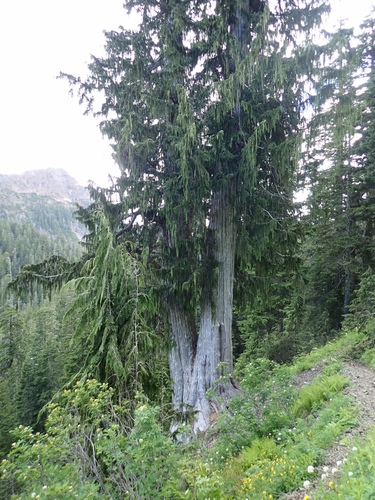
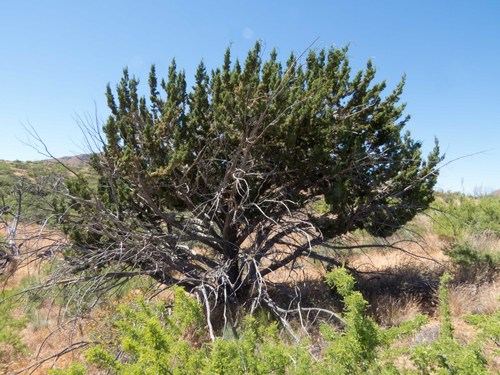
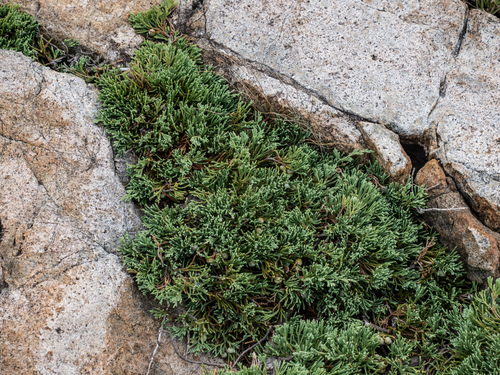
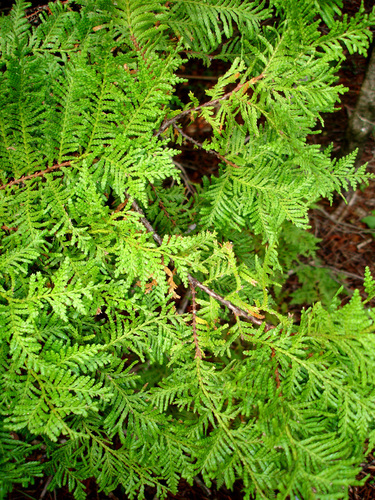
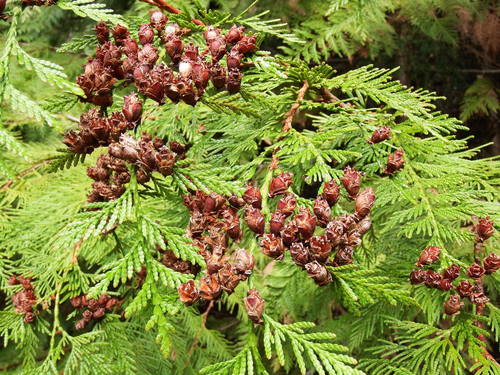
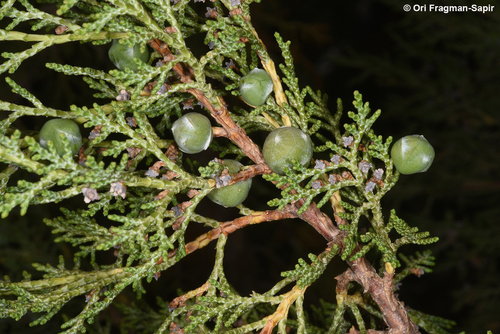
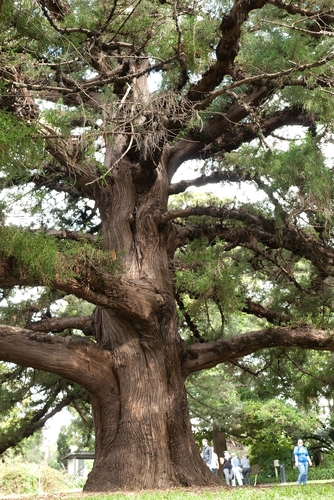
Juniperus bermudiana, commonly called the Bermuda cedar, is an evergreen tree that typically grows up to 15 metres (49 feet) tall, with a trunk up to 60 centimetres (24 inches) thick; larger specimens existed in the past. It has thin bark that sheds in strips, and produces blue-green foliage sprays. Individual foliage shoots are 1.3–1.6 millimetres (3⁄64–1⁄16 inch) wide, and quadriform (four-sided) in cross-section. Mature leaves are scale-like, 1.5–2.5 mm long (up to 4 mm long on strong-growing shoots) and 1–1.5 mm broad, with an inconspicuous gland. They are arranged in opposite decussate pairs, and occasionally form decussate whorls of three. Juvenile plants grow needle-like leaves 4–8 mm long. This species produces soft, berry-like seed cones that range in shape from irregularly globose to broad pyriform, 4–6 mm long and 5–8 mm broad. Cones start green, and mature to a bluish-purple colour around 8 months after pollination. Each cone holds one or two seeds, rarely three. Male cones are 4–6 mm long, start yellow, and turn brown after releasing pollen in early spring. In the mid-1940s, two unintentionally introduced scale insect species, Lepidosaphes newsteadi and Carulaspis minima, brought to Bermuda during the wartime construction of United States mainland airbases for the US Navy and Army Air Forces, became a major threat to the species. By 1978, these parasites had killed an estimated 8 million trees, 99% of all Bermuda cedars. The remaining 1% of the population showed some resistance to the scale insects, and propagation efforts by Bermuda's Department of Agriculture, Fisheries and Parks have helped prevent the species from extinction. In the 1950s and 1960s, Casuarina equisetifolia (common names horsetail sheoak, Australian pine), a species native to Australia, was introduced to Bermuda to replace Bermuda cedar for windbreak functions. C. equisetifolia is competitively dominant in Bermuda, as its leaf litter suppresses the germination and growth of understory plants through allelopathy. Like Bermuda cedar, C. equisetifolia is resistant to wind and salt, making it popular with Bermudian gardeners. Other introduced species planted to replace Bermuda cedar forest include the bay grape (Coccoloba uvifera). Alongside C. equisetifolia, the main introduced competitor for growing space is Brazilian pepper (Schinus terebinthifolius). Bermuda cedar is occasionally grown as an ornamental tree outside its native range, and may have become naturalised on Hawaii and Saint Helena. More than 6,500 individuals were planted in Hawaii between 1921 and 1953, and it has established wild populations there. Before widespread deforestation, Bermuda cedar forests covered much of Bermuda's landscape, providing habitat and food for many bird species that evolved to live within them. The massive loss of trees caused populations of these birds to decline to near extinction, including the Bermuda white-eyed vireo and a possible subspecies of eastern bluebird. Public and government efforts are underway to recover both bird and Bermuda cedar populations, but Bermuda cedar can take 200 years to reach full maturity, and the bird species may not survive that long. Recent sea level rise has caused seawater to immerse the roots of some low-lying old-growth cedars, leading to their death. Bermuda cedar is known for its heavy, sweet aroma, attractive and useful reddish timber, major role in Bermuda's history, and prominent presence in Bermuda's historic homes. When English settlers first arrived in Bermuda, extensive Bermuda cedar forests grew across the islands, and the species thrived even as settlers developed the land. Settlers used the timber for its durability and workability in many applications: construction of homes, churches, jails, shipbuilding, interior woodworking, furniture, and coffins, and it was also exported for sale. Settlers used the cones as food for themselves and their livestock, and made cedarberry syrup from cones to treat toothaches and coughs. They also boiled the shoots in water to create an elixir to lower fevers. The timber naturally repels moths and fleas, and prevents mildew and rot, so many Bermuda residents lined closets and drawers with it. Shipbuilders particularly prized the timber: it could be worked immediately after felling, is naturally resistant to rot and woodworms, matches oak in strength but is much lighter. These qualities contributed to the speed and maneuverability that made Bermudian ships famous and desirable. After the Somers Isles Company was dissolved in 1684, the abundance of Bermuda cedar allowed Bermudians to shift entirely to a maritime economy. Starting in 1627, local officials passed legislation to conserve Bermuda's cedar forests by restricting export of the timber for shipbuilding. Between 1693 and 1878, the Bermuda legislature passed sixteen additional acts that placed restrictions on cedar use. Despite these acts, the shipbuilding industry had cleared most of Bermuda's landscape by the 1830s. The forest only began to recover with the dawn of the age of steam-driven, steel-hulled ships. After Bermuda's economy shifted fully to maritime activities, former farmland was quickly reforested to grow timber for shipbuilding. Families jealously conserved cedar growing on their land, as the resource was scarce, highly valued, and gained value over decades as trees matured. For many generations, the British government, its local officials, and many visitors criticized Bermudians for failing to clear the forest and return to farming, a practice widely seen as idleness. In 1828, Royal Navy Purser Richard Otter wrote of the relationship between Bermudians and the cedar: Of the twelve thousand acres which Bermuda is said to contain, two thousand might be brought into cultivation if there was less veneration for cedar trees, and a trifling exertion made to drain or embank the marshes, whereas at present there are not two hundred acres disturbed by the spade or the plough; indeed there is but one plough in the Colony, and that belongs to an Englishman named Winsor, who has proved what could be made of ground apparently barren... After the 1783 independence of the continental colonies that formed the United States of America, and trade barriers raised by the new republic against British vessels in the 1820s, combined with global shifts in the shipping industry (specifically the shift from wooden sailing vessels to metal steamships), Bermuda's maritime trades and shipbuilding industry slowly declined through the 19th century, though demand for locally sourced firewood increased during this time. Many historic Bermudian homes have interior woodwork and furnishings made from Bermuda cedar, including Mayflower House, Camden House, Tucker House, and Verdmont House. According to the Bermuda National Trust, Verdmont House holds the colony's finest collection of antique Bermuda cedar furnishings. Today, Bermuda cedar timber is scarce and expensive, and its association with many grand Bermudian homes means its scent has become linked to the idea of wealth. The Bermuda hedge fund Juniperus Capital is named after this species.