About Juncus roemerianus Scheele
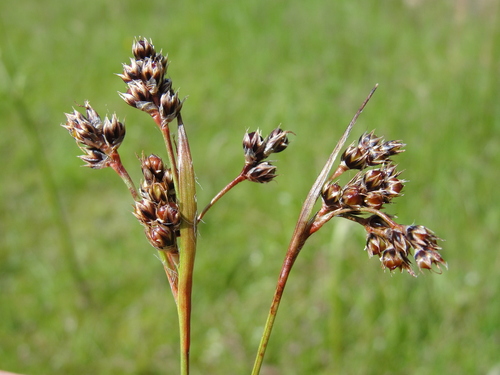
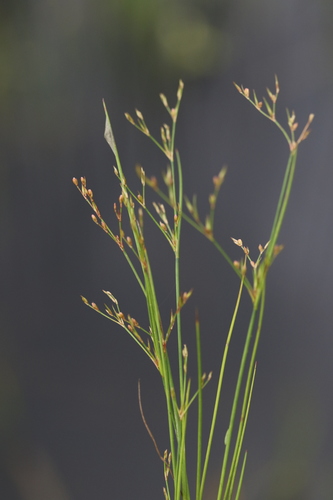
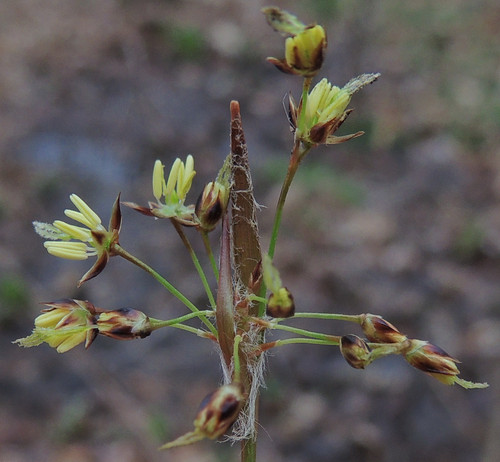
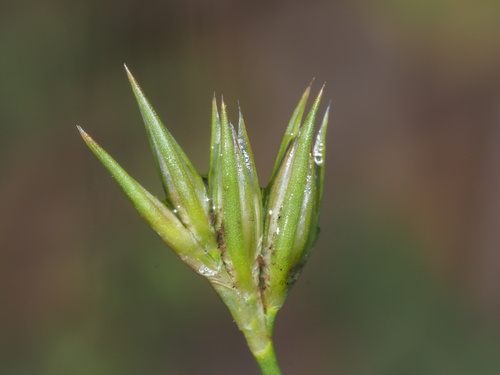
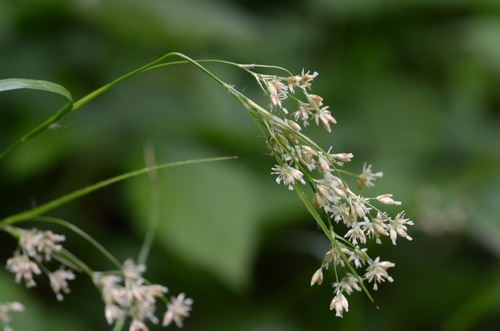
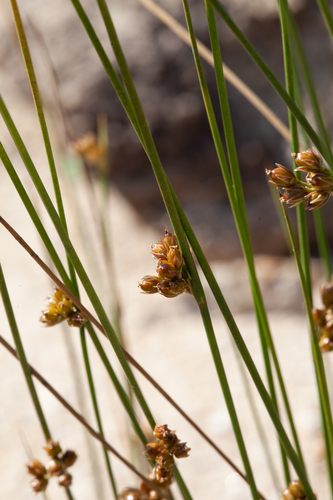
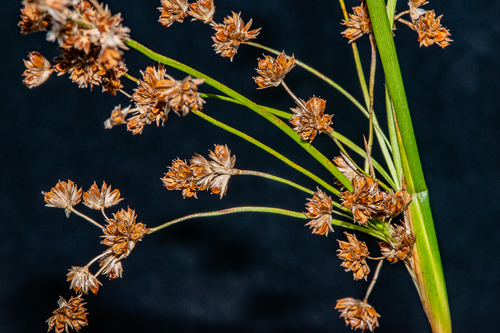
Juncus roemerianus Scheele, commonly known as this rush, is a perennial plant that grows in tufts of rough, rigid stems and leaves, with a gray-green color. At first glance, the plant may appear leafless: structures that look like sharp-pointed stems are actually stiff leaves rolled tightly into pointed cylinders, while the true stems are tipped with inflorescences. It grows from a rhizome, and its appearance is highly variable, with size and shape shaped by environmental conditions in its salt marsh habitat. In areas with low soil salinity, the plant can grow over two meters tall, while it becomes dwarfed in high-salinity areas, sometimes reaching less than 30 centimeters (12 inches) tall. Both large and small plants are typically found in a single marsh: large plants grow closest to open water, while small plants grow on higher ground in salt flats and other high-salinity areas. Size differences between plants also have a genetic basis, with soil salinity acting as the selective force that drives this genetic variation. Dwarf plants have an adaptation to high soil salinity; larger plants lack this adaptation and do not survive when experimentally transplanted to high-salinity environments. This rush reproduces both sexually via seed and vegetatively by sprouting from its spreading rhizome. It expands its dense, sometimes monotypic stands by sending up new stems from the rhizome, and establishes new stands by releasing seeds. The species is gynodioecious: some plants produce bisexual flowers, while others produce only female reproductive parts. The seeds are very viable and germinate readily, but they require light to germinate, and may fail to sprout if covered by thick mud. For this reason, seedlings are most often found in open, sandy stretches, and are rare in areas with dense vegetation or thick substrates. The plant grows new shoots and leaves year-round, and does not typically experience seasonal growth spurts. Dead leaves remain attached to the plant for a long time, leading to accumulation of plant matter, and the species can make up much of the physical structure of a salt marsh. This is a common, ecologically important plant across its native range, and it often dominates salt marshes and estuaries. In northwestern Florida, around 60% of all salt marshes are covered by this rush. It and smooth cordgrass (Spartina alterniflora) are the dominant plants in Mississippi tidal marshes. The two species often grow together: S. alterniflora occupies lower marsh levels, while J. roemerianus grows in the mid-level and upper reaches of the marsh. In river estuaries, this rush can occur 10 to 15 miles inland. Associated plants in the marsh's higher-salinity regions include saltmeadow cordgrass (S. patens), giant cordgrass (S. cynosuroides), saltgrass (Distichlis spicata), glassworts (Salicornia spp.), Olney threesquare (Scirpus americanus), and saltmarsh bulrush (Scirpus robustus). In brackish marshes, common plant associates include sealavender (Limonium carolinianum) and common arrowhead (Sagittaria latifolia). In the intermediate marsh between brackish and freshwater marsh levels, associated plants include common reed (Phragmites australis), sawgrass (Cladium jamaicense), softstem bulrush (Scirpus validus), and Virginia iris (Iris virginica). This rush provides cover for many salt marsh animal species. Birds including the long-billed marsh wren, clapper rail, and seaside sparrow nest in it. Rice rats also nest in it, and prey on the eggs of local birds. A number of fungal species grow on this rush, some exclusively. The ascomycete species Aquamarina speciosa, Keissleriella rara, Massarina carolinensis, and Paraphaeosphaeria pilleata were first described from dead or dying stems of this rush. The fungus Juncigena adarca (family Juncigenaceae, order Torpedosporales) has only been found growing on senescent (decaying) leaves of Juncus roemerianus on the Atlantic coast of North Carolina, USA. This plant shows potential for use as a phytoremediation agent after oil spills. When growing in diesel-polluted sediments, it reduces the concentration of total petroleum hydrocarbons, polycyclic aromatic hydrocarbons, and n-alkanes in the sediment.