About Juncus australis Hook.fil.
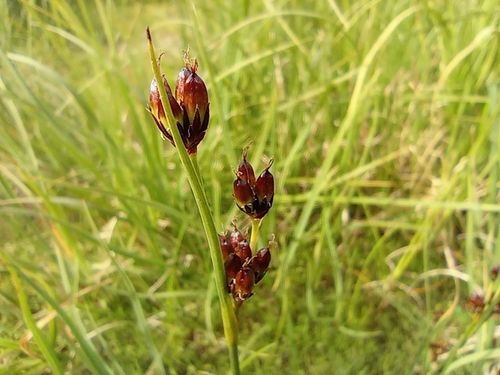
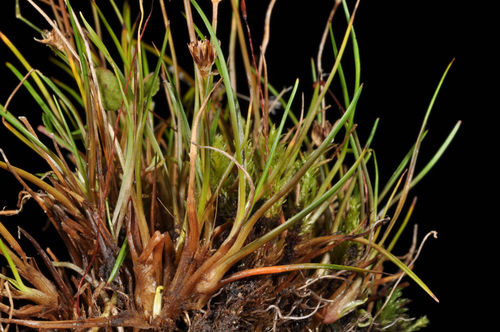
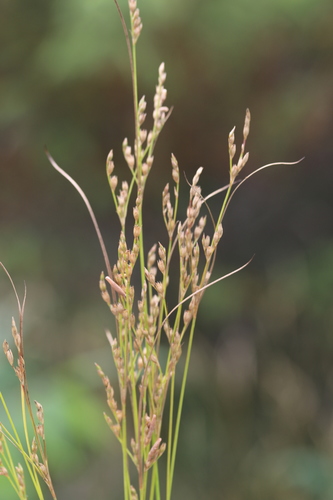
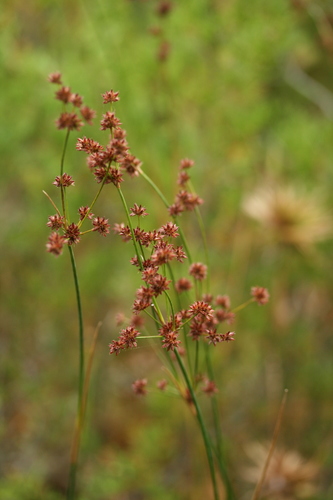
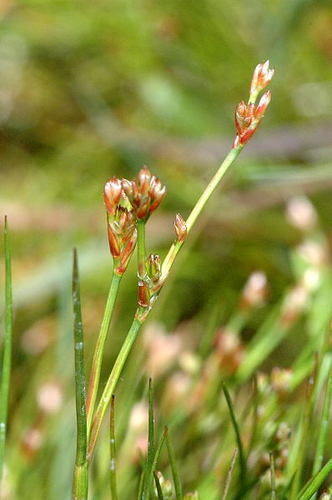
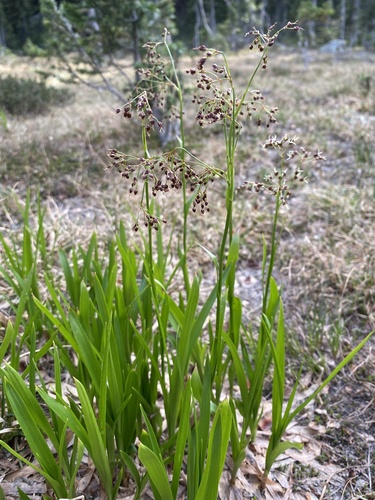
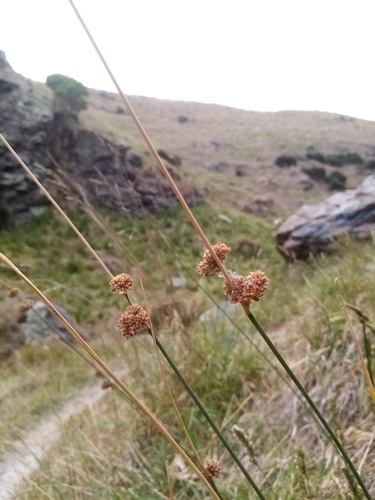
Juncus australis Hook.fil. is a perennial rush species that grows mainly in open, loosely packed circular clumps. Clumps typically form around one or a few live or dead stems at their centre, and on average grow 50 centimetres apart from other clumps. Its stems grow vertically, reach 60–120 cm in height, are tough and resistant to squashing or breaking. Culms have a dull non-shiny colour ranging from green to blue-green or grey-green, with a diameter between 1.5 millimetres and 4 millimetres. Each stem has 30–60 evenly spaced striations. The pith inside the culm is not solid throughout, and generally contains large, non-continuous air pockets. The plant has no leaves, but most culms bear several bracts that change colour from yellow to brown. Basal sheaths at the base are shiny, and range in colour from dark yellow-brown to chestnut brown. The inflorescence is lateral, with flowers clustered at the tips of stout branchlets; sometimes the clusters are condensed into a globose head. Flowers are 2.2 to 3 millimetres long, start light green, and turn light brown as the plant matures. Flower heads are branched and form one or more dense clusters. Flower tepals are straw-coloured, with a faint reddish-brown longitudinal band on either side of the straw-coloured midrib. Capsules are straw-coloured with a golden-brown apex, typically 2 to 3 millimetres long. They are usually shorter than or equal in length to the tepals, though they may exceed tepals in rare cases. Capsules have an ovoid to obovoid shape, with an obtuse, almost retuse apex. They are pale, ranging from green to greenish brown. Its rhizomes (horizontal root structures) grow just below the soil surface, and can also grow ascending. Rhizomes are 3 to 5 millimetres in diameter. Cataphylls growing from the plant base can be tight or loose, and reach up to around 22 centimetres in length. They are usually dark brown, and may be light brown less commonly. Plant structure varies with growing location. Across most of the species range, pith is interrupted or absent, but plants from higher altitudes of the Southern Tablelands have been recorded with continuous pith. Southern Tablelands plants also have more tightly clustered flower heads than plants growing at lower altitudes. This species is almost entirely naturally occurring, and is not intentionally planted widely, spreading through its effective natural propagation mechanisms. It is distributed across southeast Australia and parts of New Zealand. In New South Wales, it has been recorded as far north as Glen Innes in the North Tablelands, and occurs across most of the state extending south through the Central Tablelands and Southern Tablelands, and west as far as Wellington and Albury. It has also been recorded in coastal areas of the Central Coast and South Coast, and in the alpine regions of the Snowy Mountains. It occurs across much of Victoria, with the densest distribution on the eastern side of the state, continuing the coastal distribution from New South Wales into southeastern Australia. While predominantly found along the southeastern Australian coast, mainly in New South Wales and Victoria, it has also been recorded in Queensland, South Australia, the Australian Capital Territory, Tasmania, and the external Australian territory of Norfolk Island. A single outlier recording from far north Queensland places it as far north as Cairns, far outside its main range. The Australasian Virtual Herbarium holds 863 recorded sightings of this species: 213 are from Victoria and 269 are from New South Wales, confirming its densest distribution in southeastern Australia. In New Zealand, it has been recorded on both the North and South Islands, as well as on the Kermadec Islands, an uninhabited island arc northeast of the North Island. It follows the typical seasonal pattern of its native temperate climate. It flowers from September to December, aligning with Southern Hemisphere spring, and fruits from November to May. Its mucilaginous seeds can disperse via attachment, water, and wind. The waxy mucilaginous coating helps seeds float, enabling easy dispersal by water movement. Wind dispersal is supported by propagules that have a high surface area to volume ratio, which increases air resistance to let propagules travel further. This variety of dispersal methods means the species can be easily grown from fresh seed. As a perennial species, it lives longer than one year, and survives through winter to bloom again the following spring. Humans do not often use Juncus australis, and almost all populations are naturally occurring in their native habitats. It is often considered a weed, especially when it invades pasture land, and is not and is unlikely to become a popular garden plant. It does have some landscape uses: due to its natural growth in wetlands and damp soils, it is useful for planting along the edges of water bodies such as dams and waterways to stabilise banks. It is also grown as an ornamental plant, and provides habitat for waterbirds around ponds. As a tough rush, it works well as an ornamental planting around creeks and ponds, for both single feature plantings and mass plantings. It is occasionally sold by specialist native plant nurseries. There is some evidence that Aboriginal people may have used this plant traditionally. Its seeds have been identified as a potential traditional food source. Stems of Juncus species have been used as fibre for making string and baskets. This aligns with the origin of the genus name: juncus comes from the Latin word jungere, meaning to tie or bind, referencing the traditional use of Juncus stems to make cord.