About Juncus articulatus L.
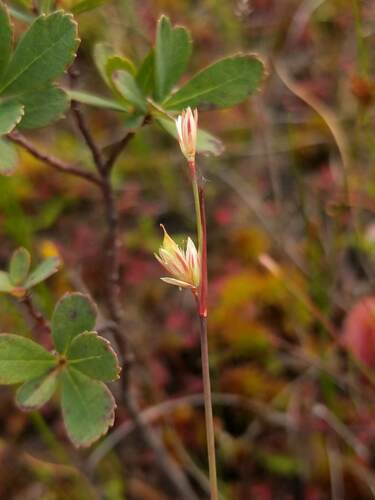
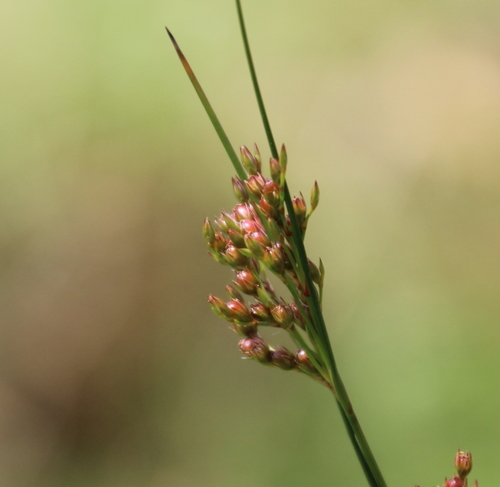
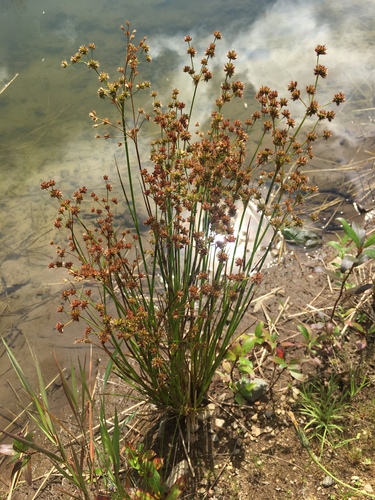
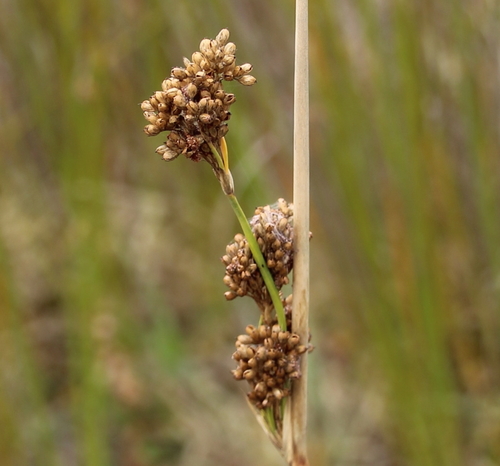
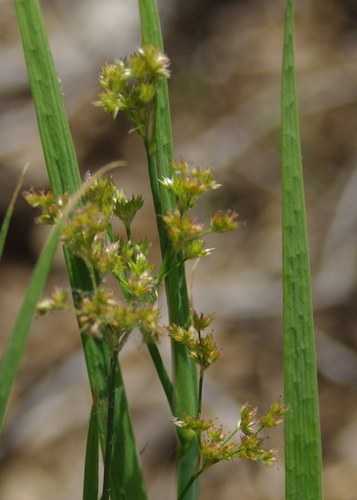
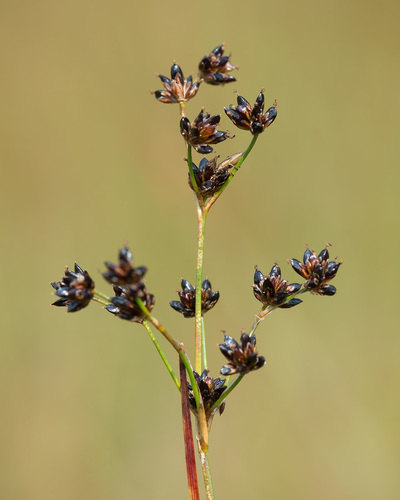
Juncus articulatus L. is a flowering plant species in the rush family Juncaceae. Its common names are jointleaf rush and jointed rush, though this common name can also refer to the Australian species J. kraussii. This rush is native to Eurasia, Canada, Greenland, and most of the United States. It grows in moist areas such as wet sand, and grows best in calcareous soils. Compared to its related species J. acutus and J. maritimus, J. articulatus is more sensitive to drought and salt stress. It is a perennial herb that grows mostly erect stems from a short rhizome. Stems may root at their nodes, and the plant typically has one or more flattened, hollow, cylindrical leaves that reach up to 10 centimeters in length. Transverse internal partitions (or joints) can be seen or felt within the plant's leaves. The inflorescence at the top of the stem has several branches, holding up to 25 flower clusters that each contain up to 12 individual flowers. Each flower has greenish to dark brown pointed tepals that measure 2 to 3 millimeters long, six stamens that bear anthers, and a protruding feathery pistil. Its fruit is a dark brown capsule with a pointed tip.