About Juncus acutus L.
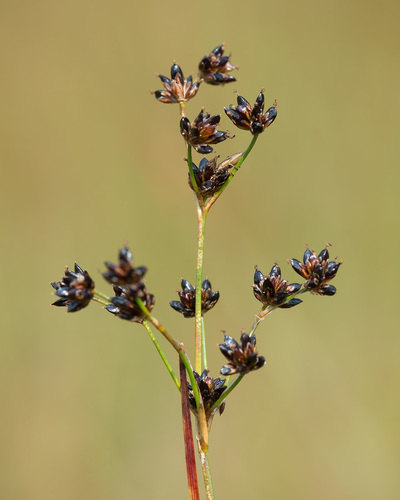
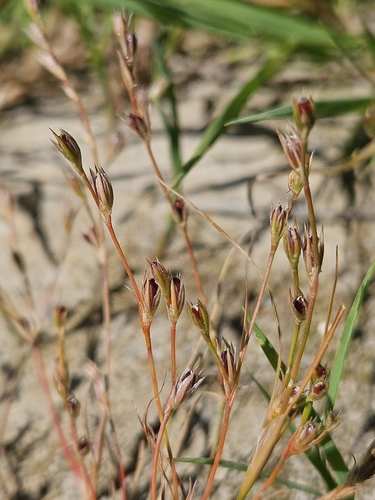
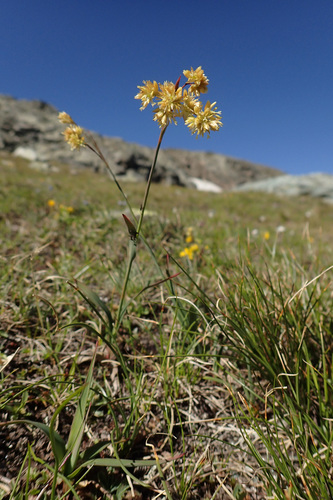
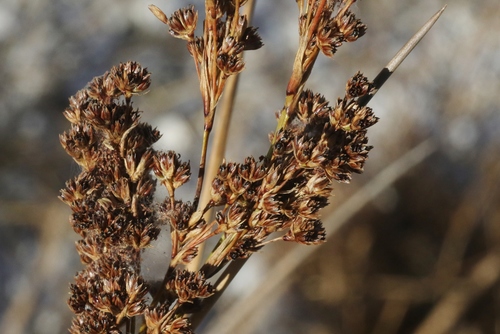
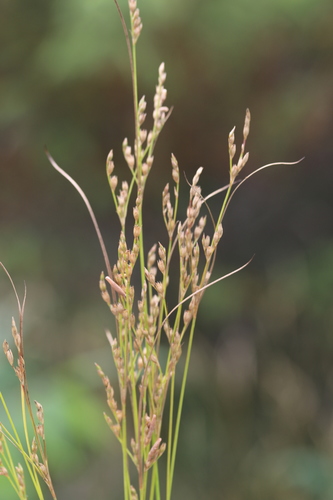
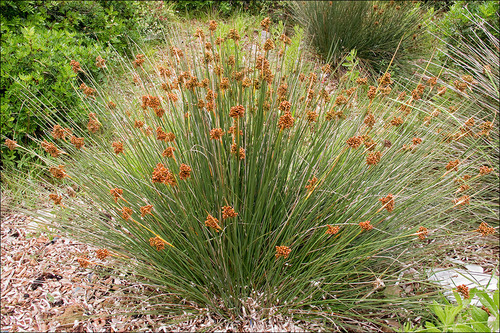
Juncus acutus L. is a brown and green, tussock-forming perennial plant that can grow up to 1.5 metres (4.9 ft) tall. It grows in a wide range of soil types, occurring in habitats that experience extreme fluctuations between flood and dry conditions, such as dunes, as well as consistently wet environments including lowland grassland, grassy woodland, riparian vegetation, freshwater wetlands, and saline and subsaline wetlands. Its pith-filled stems and leaves grow from the base at varying angles, giving the plant an overall rounded, globe-like shape. Leaves form a basal sheath around the flower stem leaves and end in a stiff, sharp point. Flower stems are 2 millimetres (0.079 in) to 4 millimetres (0.16 in) in diameter and 4 centimetres (1.6 in) to 13 centimetres (5.1 in) long, and resemble the plant's leaves. Flower stems emerge from the base at all angles, and each stem bears 1 to 6 flowers. Each flower has 6 stamens and bracts that measure 4 centimetres (1.6 in) to 25 centimetres (9.8 in) long and end in a stiff, sharp point. The flowers are hermaphrodite and pollinated by wind. Fruits are oval, 3-celled brown capsules measuring 4 millimetres (0.16 in) to 6 millimetres (0.24 in) long. The brown seeds are 1.2 millimetres (0.047 in) to 2 millimetres (0.079 in) long and have a tail at each end. The plant has short, robust rhizomes. Juncus acutus is principally found in low-lying, damp, low-fertility areas such as sandy seashores, dune slacks, and coastal flats. It also occurs occasionally in salt marshes, disturbed saline areas, mine dumps, lowland grassland, grassy woodland, riparian vegetation, freshwater wetlands, and saline and subsaline wetlands. Its documented distribution spans the Palearctic realm: Northern Africa (Algeria, Egypt, Morocco), Western Asia (Iran, Iraq, Israel, Jordan, Lebanon, Turkey), the Caucasus (Armenia, Azerbaijan, Georgia), Northern Europe (the British Isles), Southeastern Europe (Albania, Crete, Greece, Italy, Kosovo, Montenegro, Sardinia, Serbia, Sicily, Malta), and Southwestern Europe (Azores, Balearic Islands, Corsica, France, Portugal, Spain). It is also present in the Nearctic realm, in Baja California, Northern America.