About Jeffersonia diphylla (L.) Pers.
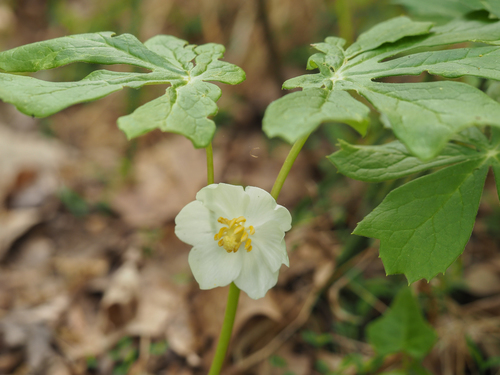
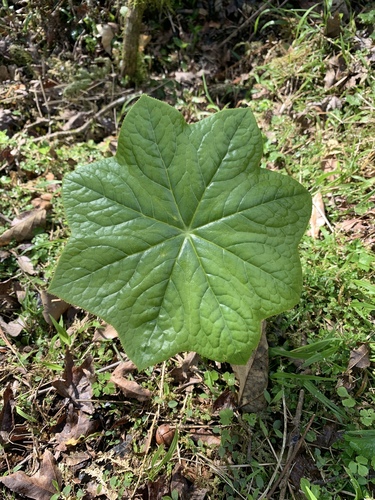
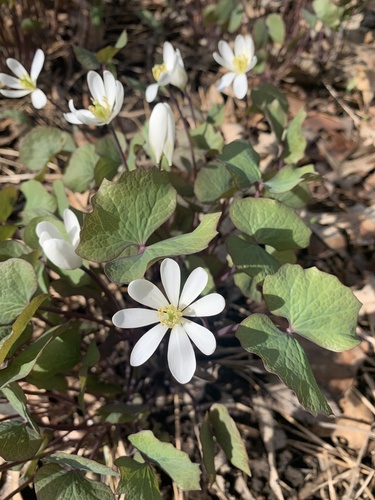
Jeffersonia diphylla produces smooth leaves and flowers that emerge directly from its rhizome. Its leaves are split into two leaflets that are half-ovate, with either smooth entire margins or shallowly toothed edges. The plant bears showy white flowers, which have four sepals, eight petals, eight stamens, and a single pistil; these flowers resemble the flowers of bloodroot. The short-lived flowers bloom in April or May, before the forest canopy fully develops, making this species a spring ephemeral. The fruit of Jeffersonia diphylla is a green, pear-shaped capsule with a hinged top. Its characteristic large leaves are nearly split completely in half, which gives the plant its common name of twinleaf. It rarely grows taller than 12 inches (30 cm). Like other deciduous forest plants, Jeffersonia diphylla spreads its seeds through dispersal by ants, a process called myrmecochory. This species is native to Eastern North America, with a range extending from Minnesota east to New York, and south to Tennessee. In Minnesota, it only occurs in the lower southeastern part of the state, where it grows in mesic deciduous forests, most often in ravines or on talus slopes. In this state, it prefers to grow on calcareous soils located on north and east-facing slopes, and it is classified as a threatened species here. In Minnesota, it grows alongside other uncommon woodland plants, including Hydrastis canadensis (golden seal) and Dicentra canadensis (squirrel-corn). Jeffersonia has been used for a variety of medicinal purposes. One historical use is reflected in its archaic common name, rheumatism root. The roots of both Jeffersonia species contain berberine, a documented anti-tumor alkaloid, so the plant is considered poisonous.