About Jatropha podagrica Hook.
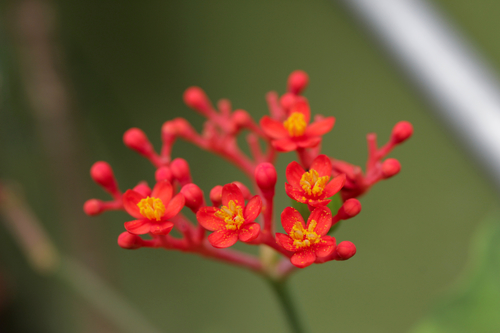
Jatropha podagrica Hook. is a caudiciform perennial herb that grows up to 1 metre (3 feet) tall. Its grey-green, knobby, swollen caudex has a bottle-like appearance, which is the origin of some of its common names. Its leaves grow on long, fleshy, stout petioles that emerge from the tip of the stem and radiate outward in all directions. The leaves are peltate and have either 3 or 5 lobes. Dense clusters of small orange-red flowers grow above the leaves on long, slender peduncles. These clusters contain both male and female flowers, and flowering occurs through most of the year. Its fruits start as green capsules, and turn blackish-brown when they reach maturity. At maturity, the capsules burst and scatter their seeds up to 4 metres (13 feet) away. When cut, this plant produces a large amount of sticky sap that may cause dermatitis if it touches skin. All parts of Jatropha podagrica are considered toxic, especially the seeds. The main toxins are a purgative oil and a phytotoxin or toxalbumin called curcin, which is similar to the ricin found in Ricinis. The swollen caudex, showy leaves, and colourful flowers make Jatropha podagrica an attractive ornamental plant, and it is grown as an indoor plant in many regions across the world. Jatropha podagrica has many traditional uses in folk medicine, and several significant research projects have been launched to explore the species' potential health benefits. Multiple projects have aimed to identify medicinally useful compounds found in Jatropha podagrica, which may have potential applications as an analgesic, aphrodisiac, antimicrobial or disinfectant, antivenin, gout treatment, intestinal parasite purge, laxative, and tonic, alongside other potential uses. Industrial and practical uses of the plant include potential applications as a source of biofuel, dye, pest control, plant fertiliser, soap, and a natural form of lighting or lamp oil (typically kerosene), as well as use for leather processing and tanning.