About Jatropha gossypiifolia L.
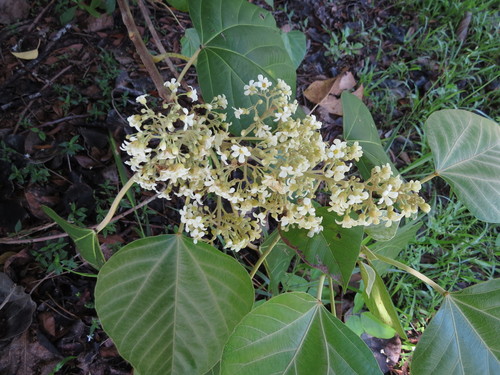
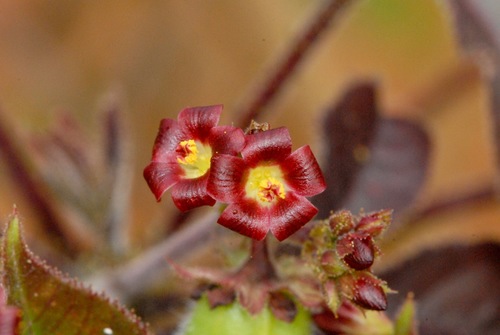
Jatropha gossypiifolia L., commonly called bellyache bush, black physicnut, or cotton-leaf physicnut, is a flowering plant species belonging to the spurge family, Euphorbiaceae. It is native to Mexico, South America, and the Caribbean islands, and has since spread across all tropical regions. It is classified as a noxious weed in Puerto Rico, and is naturalized in northern Australia, including Queensland where it is listed as a Class 2 declared pest plant. This plant grows to a height of 2.5–4 meters (8.2–13.1 feet). Its three-lobed leaves are purple and sticky when young, and turn bright green as they mature. It produces clusters of small red flowers with yellow centers, which are followed by cherry-sized poisonous seed pods. Cases of powdery mildew fungal infection in this species have been reported. Jatropha gossypiifolia has many common names across different languages and regions: in English it is known as bellyache-bush, black physicnut, and cotton-leaf physicnut; in Spanish it is called pinon negro, pinon colorado, and tua-tua; in French it goes by medicinier noir and medicinier rouge; in Brazil it is named mamoninha and peao-roxo; in Thailand it is called jarak ulung; and in India it is known as jarak merah and sibidigua. This plant has a range of documented traditional medicinal uses for both humans and animals, using different plant parts including leaves, stems, roots, seeds, and latex. Preparations are made via methods such as infusion, decoction, and maceration, and administered through either oral or topical routes. The most commonly reported effects of these preparations include antihypertensive, anti-inflammatory, antiophidian, analgesic, antipyretic, antimicrobial, wound healing, antianemic, antidiabetic, and antihemorrhagic activities, among many others. Beyond medicinal uses, the plant is also used for biodiesel production, as a pesticide, insecticide, and vermifuge, as an ornamental plant, and even in religious rituals. Benjamin Franklin's reference work The American Instructor notes it can be used as an abortion tonic alongside pennyroyal for treating suppressed menstruation in unmarried women, stating the following: "Now I am upon Female Infirmities, it will not be unreasonable to touch upon a common Complaint among unmarried women, namely The Suppression of the Courses. This don't only disparage their Complexions, but fills them besides with sundry Disorders. For this Misfortune, you must purge with Highland Flagg (commonly called Belly ach Root) a Week before you expect to be out of Order ; and repeat the same two Days after: the next Morning drink a Quarter of a Pint of Pennyroyal Water, or Decoction, and as much again at Night when you go to Bed. Continue this 9 Days running ; and after resting 3 Days, go on with it for 9 more. Ride out every fair Day, stir nimbly about your Affairs, and breathe as much as possible in the open Air." This herb has been traditionally used as an oral contraceptive and abortifacient. Studies show ethanol extracts of the plant are effective at reducing fertility in rats, though the specific chemicals responsible for this endocrine disruption have not yet been identified.