About Jatropha dioica Sessé
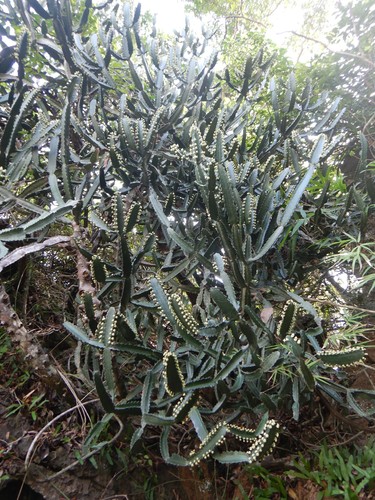
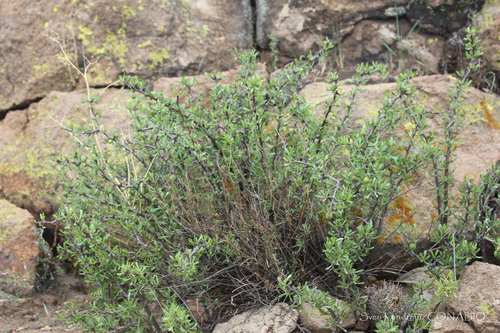
Jatropha dioica Sessé forms colonies from underground rhizomes. Its arching, succulent stems grow to a height of 20–60 cm, have few branches, and are tough and flexible enough to be tied into overhand knots without breaking. Its spreading orange rootstock reaches around 1 meter in length. Leaves are simple, arranged alternately or in fascicles, and clustered on short shoots growing from the stems. They are nearly stalkless and have smooth entire margins. The leaves of the nominate variety are linear, measuring up to 6 × 1 cm, while leaves of J. dioica var. graminea can be 2 to 3-lobed and measure up to 6.5 × 0.5 cm. Male flowers grow in clustered cymes; they have 3.5 mm sepals, 5 mm petals, and 10 stamens. Female flowers are pitcher-shaped (urceolate) with 5 mm petals that curve back at the tips. Jatropha dioica blooms in spring and early summer. Its fruit is a 5 × 12 mm capsule that contains 1 to 2 cells. Seeds are roughly spherical and measure 1 × 1 cm. The nominate variety grows in southern and western Texas, Tamaulipas, Nuevo León, and from Durango to Oaxaca. J. dioica var. graminea occurs from Chihuahua to Zacatecas and also in the Trans-Pecos region of Texas. The type specimen of this species was collected in Jimulco, Coahuila. Also called Sangre de drago and leatherstem, Jatropha dioica acts as a nurse plant for small cacti including Lophophora species. Its seeds are eaten by white-winged doves (Zenaida asiatica). It is traditionally used to treat dental problems including gingivitis, loose teeth, bleeding gums, and toothache. Its latex is an astringent, and can also be used as a red dye. It is sometimes grown as an ornamental plant in xeriscapes and rock gardens.