About Jatropha curcas L.
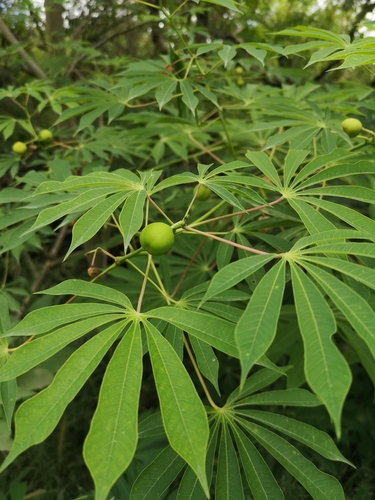
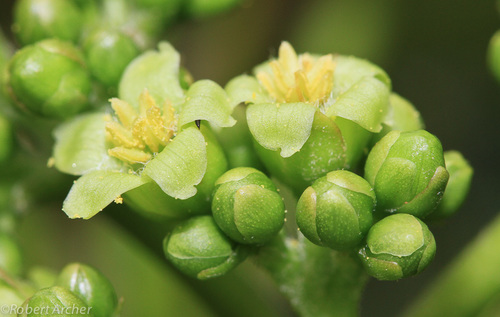
Jatropha curcas L. has leaves with variable morphology: generally green to pale green, alternate to subopposite, three- to five-lobed, arranged in spiral phyllotaxis. This species produces male and female flowers on the same inflorescence, which forms in the leaf axil, with an average ratio of 10 to 20 male flowers per female flower. Occasional plants produce hermaphroditic flowers. Fruits are typically produced in winter, but multiple crops can occur per year with good soil moisture and sufficiently high temperatures. Most fruit production runs from midsummer to late fall; some plants produce two or three harvests, while others fruit continuously through the growing season. Seeds mature when their capsule changes from green to yellow. By weight, seeds yield 25–40% oil, and contain approximately 20% saturated fatty acids and 80% unsaturated fatty acids. The oil is mostly composed of oleic and linoleic acids. Additional chemical compounds in seeds include saccharose, raffinose, stachyose, glucose, fructose, galactose, and protein. The plant also contains curcasin, arachidic acid, myristic acid, palmitic acid, stearic acid, and curcin. The full genome of Jatropha curcas L. was sequenced by the Kazusa DNA Research Institute in Chiba, Japan, in October 2010. Cultivation of Jatropha curcas L. is straightforward. It grows in tropical and subtropical regions, and can grow in wastelands across almost any terrain, including gravelly, sandy, and saline soils, and can thrive in poor, stony soils, though recent research indicates its ability to adapt to these poor soils is less extensive than previously thought. Complete germination occurs within 9 days. Adding manure during germination has negative effects on this growth phase, but it is beneficial if applied after germination is complete. It can be propagated by cuttings, which produces faster results than propagation by seed. Flowers only develop terminally, at the end of a stem, so plants with good ramification (many branches) produce the greatest amount of fruit. This species is self-compatible. The ratio of female to male flowers within an inflorescence also affects productivity: more female flowers produce more fruit. Jatropha curcas L. can thrive with only 250 mm (10 in) of rain per year, and only requires additional watering at the end of the dry season during its first two years of growth. Regular ploughing and planting are not needed, as this shrub has an approximate life expectancy of forty years. Pesticides are not required, because the plant has natural pesticidal and fungicidal properties. It is used in rural Bengal to treat dhobi itch, a common fungal skin infection. Jatropha curcas L. begins producing seeds 9–12 months after planting, and reaches maximum seed yield after 2–3 years. Average seed production is around 3.5 tons per hectare, ranging from approximately 0.4 t/ha in the first year to over 5 t/ha after 3 years. When planted as live hedge fences, reported productivity ranges from 0.8 to 1.0 kg of seed per meter of fence. In the developing world, oil from Jatropha curcas L. seeds is used to produce biodiesel fuel in the Philippines, Pakistan, and Brazil, where it grows naturally and in plantations in southeast, north, and northeast Brazil. In the Gran Chaco region of Paraguay, where a related native variety Jatropha matacensis also grows, studies have confirmed Jatropha curcas cultivation is suitable, and agricultural producers are beginning to consider planting it here. In Africa, Jatropha cultivation is promoted and grown successfully in countries including Mali. In Mexico, edible non-toxic Jatropha curcas L. is known by multiple common names including Xuta, chuta, aishte, and piñón manso. It is grown in small areas such as home gardens. While Jatropha curcas is widely known as a toxic plant due to the presence of diterpene compounds called phorbol esters, the existence of non-toxic, edible varieties that do not contain phorbol esters has been confirmed. It is also reported that Jatropha seeds are edible after the embryo is removed. Phorbol ester content in J. curcas is analyzed using high-performance liquid chromatography (HPLC). Xuta is traditionally prepared for local celebrations and popular gatherings. The kernels are roasted and eaten as a snack, or roasted and ground to make dishes including tamales, soups, and sauces such as pipian. In the area around Misantla, Veracruz, the population values the seeds as food after boiling and roasting. Root ashes from the plant are used as a salt substitute. HCN and rotenone are present in the plant. In 2023, 10 children in the Philippines became ill after consuming J. curcas seeds, after watching a social media video that claimed the seeds were safe to eat. This species is listed as a honey plant, and hydrogen cyanide is present in its flowers. In Haiti, Jatropha nuts are processed into briquettes for home cooking fuel to replace charcoal from timber. They can also be burned like candlenuts when strung on grass. Hydrogen cyanide is present in the nuts, and nuts are used as a contraceptive in South Sudan. There is interest in producing animal feed from the bio-waste left after oil is pressed from seeds, particularly in Haiti, where Jatropha curcas grows prolifically and animal feed is scarce. In Haitian culture, the plant has long been used as a medicinal crop called metsiyen (or medsiyen); some sources state it calms the stomach. Seeds are also used as a contraceptive in South Sudan. Jatropha oil has been used for illumination, to make soap and candles, to adulterate olive oil, and to produce Turkey red oil. Turkey red oil, also called sulphonated (or sulfated) castor oil, is the only oil that fully disperses in water. It is made by adding sulfuric acid to pure Jatropha oil. It was the first synthetic detergent developed after plain soap, and is easily used to make bath oil products. It is also used to formulate lubricants, softeners, and dyeing assistants. The bark is used as a fish poison, and hydrogen cyanide is present in the bark. In 2009, Igbinosa and colleagues demonstrated that J. curcas bark extract has potential broad-spectrum antimicrobial activity. Latex from Jatropha curcas L. strongly inhibits watermelon mosaic virus. Leaf sap can be used to blow bubbles. Sap stains linen, and is sometimes used for marking. The shrub is used for erosion control.