About Jasione montana L.
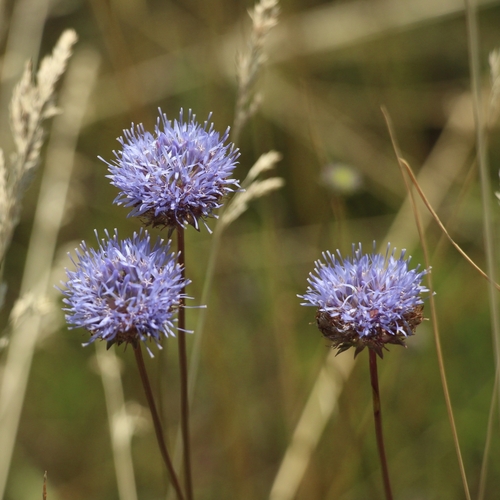
Sheep's bit scabious (Jasione montana L.) is a low-growing biennial, or occasionally annual, plant that reaches up to about one foot in height. It has suberect stems that branch near the base. Its leaves are linear, lanceolate, narrow at the base, sinuate, and covered in stiff hairs, and they grow in a basal rosette. Small violet-blue flowers are arranged in small heads. The flower bracts can be either smooth or hairy, and the petals have narrow lobes. This species has five oblong anthers that join at the base to form a tube, a characteristic that distinguishes it from true scabiouses. Individual florets open one after another successively. The anthers mature first, and later the styles elongate to expose their two-lobed stigmas; this arrangement is thought to reduce the chance of self-pollination. Nectaries are located in the upper part of the plant's ovaries, so many insects visit its flowers. Around fifty species of bees and wasps, thirty species of flies, thirty species of butterflies and moths, and several beetles have been recorded visiting these flowers, meaning this plant has a generalized pollination syndrome. The flowers are visible under ultraviolet light, which is believed to make them attractive to pollinating insects. They do not display a traditional bull's-eye guidance pattern for insects, but their petals have very high ultraviolet reflectance. This plant occurs in the temperate zone of Europe and northwestern Africa. It grows on heaths and moors in rocky or sandy districts, as well as on coastal cliffs, in quarries, and on natural escarpments where the soil is thin. It prefers acid soils and is not found in limestone regions. It often grows on coastal cliffs alongside thrift and kidney vetch, and blooms from May to September.