About Jamides bochus Stoll, 1782
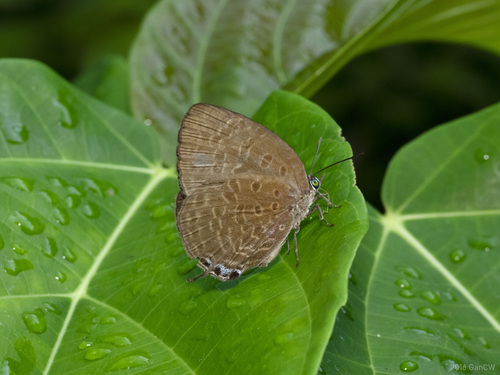
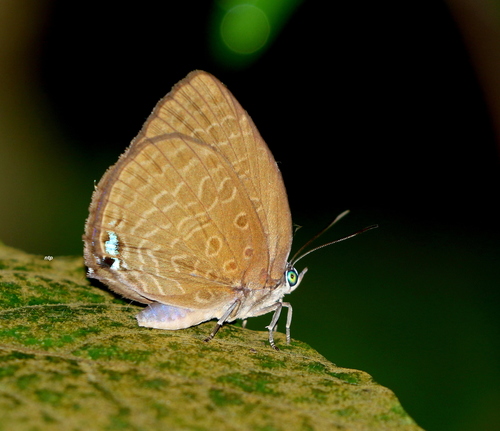
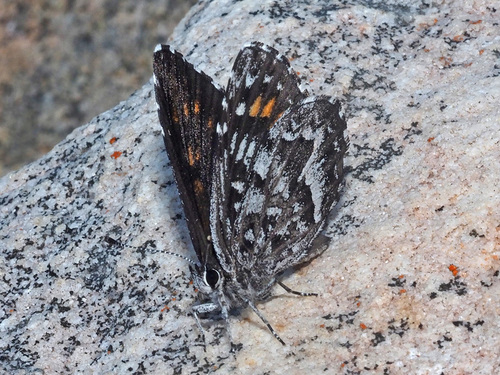
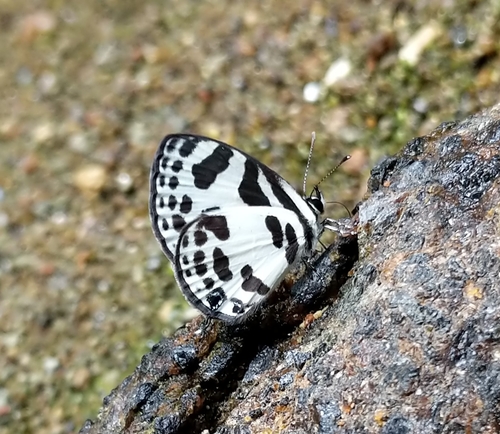
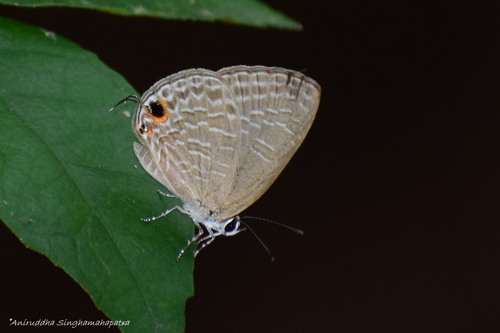
This species has the scientific name Jamides bochus Stoll, 1782. For males: on the upperside, the forewing has velvety jet black colour, with a deep, beautifully metallic and shining blue area at its base. Along the dorsum, this blue colour covers three-fourths of the length measured from the base. The outer margin of the blue area curves upward just past the apex of the cell, enters the bases of interspaces 10, 11, and 12, and fills the entire cell. For the male hindwing: the costal margin above the subcostal vein and vein 7, and the dorsal margin, are narrowly fuscous black, with a medial longitudinal pale streak on the costal margin. The terminal margin has a narrow edge of velvety black. Inside this black edge, in interspaces 1 and 2, there is a slender transverse whitish line. Above this line in interspace 1 lies an elongate irregular transverse black spot, and a similar more obscure spot in interspace 2. Some specimens also show traces of these spots in the anterior interspaces. The cilia of both forewings and hindwings are black. The filamentous tail at the apex of vein 2 is black, tipped with white. On the underside, the colour is dark chocolate brown. Both forewings and hindwings are crossed transversely by a set of very slender white lines, all more or less broken into short segments. On the forewing, a short pair of lines lie one on each side of and parallel to the discocellulars, with a pale streak along the discocellulars themselves. A single line, continuing the outer discocellular line, extends down to vein 1. An upper discal pair of lines forms a more or less catenulated (chain-like) short band that extends from the costa to vein 3; the inner of the two lines continues to vein 1. There are two more obscure subterminal lines and one single terminal line. The area enclosed between the subterminal lines, and between the subterminal lines and the terminal line, is darker in the interspaces, creating the appearance of two obscure subterminal lines of spots edged inwardly and outwardly by white lines. On the male hindwing, nine very broken and irregular lines cross the wing. When traced from the costa downward, the middle short pieces of these lines are shifted outward, and some lines are short and incomplete. The two innermost lines bend abruptly upward toward the posterior end. The two subterminal lines are lunular, and the terminal line is nearly continuous. Toward the posterior end, between the pair of subterminal lines, interspace 1 holds a small black spot edged inwardly with dark ochraceous, and interspace 2 holds a much larger round black spot. Both of these black spots are touched with metallic blue scales. The antennae, head, thorax, and abdomen are black; the shafts of the antennae are speckled with white. On the underside, the palpi, thorax, and abdomen have a narrow white stripe running down the middle. Females are generally similar to males, with the following differences. On the upperside of the female forewing, the ground colour is opaque fuscous black, not velvety black. The blue basal area is more restricted, and is not as deep blue nor metallic at all. On the female hindwing, the black costal and terminal margins are much broader, so the blue on the basal area is correspondingly much more restricted, and matches the blue shade of the forewing. The terminal margin has a subterminal series of spots that is anteriorly obsolescent; these spots are a darker shade than the terminal black area they sit on. Posteriorly, these spots are more or less distinctly encircled with slender bluish white lines, while these lines are almost obsolete anteriorly. The cilia of both forewings and hindwings, and the short filamentous tail, match those of the male. The underside is similar to that of the male, but the overall ground colour is paler and duller; the transverse white lines are broader and more clearly defined. The antennae, head, thorax, and abdomen match those of the male. This species is distributed across Peninsular India, excluding very dry or desert tracts; it is also found in Sri Lanka, Assam, Nepal, Myanmar, Tenasserim, and the Andamans, and extends through the Malayan subregion to Australia and Taiwan. Regarding its life cycle: larvae collected at Karwar in June are barely distinguishable from larvae of Catochrysops pandava Horsfield. This species' larva is covered in minute hairs, generally olive-green in colour, and lacks the reddish suffusion commonly seen in C. pandava. The pupa is indistinguishable from that of C. pandava. Larvae feed on Xylia dolabrifornis, and also on the flowers of Butea frondosa. Millettia peguensis has also been recorded as an additional food plant for the larvae.