About Jalmenus evagoras (Donovan, 1805)
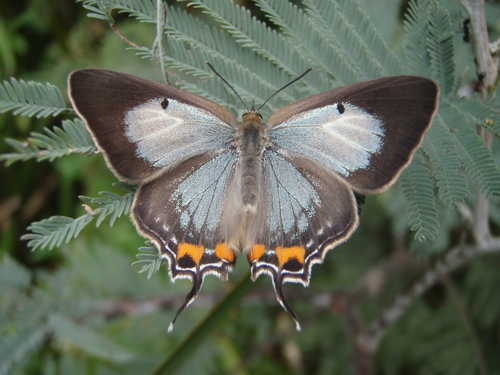
Jalmenus evagoras, commonly known as the common imperial blue, has metallic blue wings outlined in black. Its hindwings feature tails and orange spots near their lower edge. On the underside of the wings, the color is buff, marked with black streaks; the orange spots on the underside of the hindwings match those on the upper side of the wings. This butterfly reaches a maximum wingspan of 4 centimeters. Adult males and females show little to no sexual dimorphism, but in the pupal stage, females can be up to 60% larger than males. This species is found along the east coast of Australia, occurring in Queensland, New South Wales, Victoria, and the Australian Capital Territory. Populations are distributed sporadically across this range, which is partially caused by the species' requirement for nitrogen-rich host plants and specific attendant ant species from the genus Iridomyrmex. While the required host plants are continuously distributed across the range, not all of these plants meet the nutritional needs J. evagoras requires for its mutualism with Iridomyrmex ants, nor do all areas with suitable host plants overlap with Iridomyrmex ant colonies. J. evagoras lives in small breeding populations called demes, which occupy limited areas that may be as small as a single tree. This species has a high level of site fidelity: most adult butterflies remain in the same location for almost the entirety of their adult lives. J. evagoras is multivoltine, meaning it completes multiple breeding cycles per year. In the southern portion of its range, it typically produces two broods annually, while in the northern portion it typically produces three or four broods per year.