About Jacobaea vulgaris Gaertn.
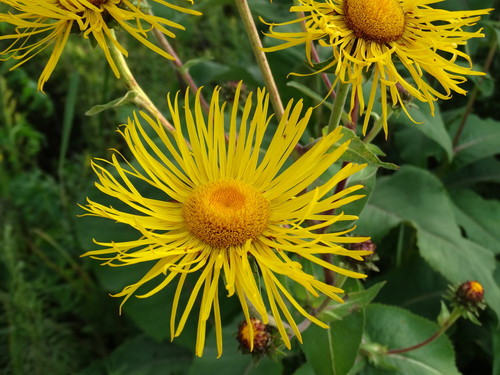
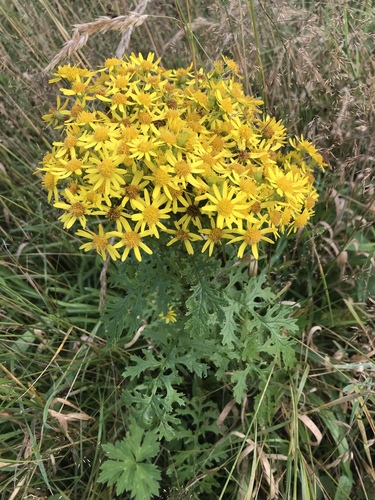
Jacobaea vulgaris Gaertn. is generally considered a biennial plant, but it can develop perennial characteristics under certain conditions, such as when it is repeatedly grazed or mowed. Its stems are erect, straight, hairless or nearly hairless, and grow to a height of 0.3 to 2.0 metres (1 ft 0 in to 6 ft 7 in). Its leaves are pinnately lobed, with a blunt end lobe. The unpleasant smell of its leaves is the reason many of its common names include the word "stinking", such as the name Mare's Fart. This species produces hermaphrodite flower heads 1.5 to 2.5 centimetres (0.6 to 1.0 in) in diameter, arranged in dense, flat-topped clusters. All florets are bright yellow. In the Northern Hemisphere, it has a long flowering period that runs from June to November. A wide range of bees, flies, moths, and butterflies pollinate this plant. In one growing season, a single plant can produce 2,000 to 2,500 yellow flowers grouped into 20 to 60 heads in flat-topped corymbs. Its achenes have dandelion-like clusters of prickly hairs called pappi that help the wind disperse the seeds. A single plant can produce as many as 75,000 to 120,000 seeds, but very few of these seeds grow into new plants in the species' native Eurasian range. Research also shows most seeds do not travel far from the parent plant. This species is native to the Eurasian continent. It is widespread across Europe, ranging from Scandinavia to the Mediterranean. It is native to Great Britain and Ireland, where it is listed as a noxious weed. It grows abundantly on waste land, waysides, and grazing pastures. Its natural habitat is sand dunes, but it is also commonly found along roadsides, railways, and in light, low-fertility soil. It has been introduced to many other regions, and is classified as a weed in most of these. Introduced locations include: North America (the United States, found mainly in the northwest and northeast, specifically in California, Idaho, Illinois, Maine, Massachusetts, Michigan, Montana, New Jersey, New York, Oregon, Pennsylvania, and Washington); South America (Argentina); Africa (North Africa); Asia (India and Siberia); and Australasia, where it is a widespread weed in New Zealand and Australia. Jacobaea vulgaris contains many different alkaloids that make it poisonous to many animals. The WHO EHC 80 report confirms these alkaloids include jacobine, jaconine, jacozine, otosenine, retrorsine, seneciphylline, senecionine, and senkirkine. Alkaloid profiles and total alkaloid content vary drastically even between plants growing in the same location. The species is a particular concern for people who keep horses and cattle. In regions where ragwort is native, such as Britain and continental Europe, confirmed documented cases of poisoning are rare. Horses and cattle usually recognize fresh ragwort and avoid eating it because of its taste. However, they may consume it if there is not enough other forage available. If ragwort ends up in hay or silage, livestock cannot recognize it, and it will contaminate the entire batch. If a sufficient quantity is consumed, the result can be irreversible liver cirrhosis in the form of megalocytosis, where liver cells become abnormally enlarged. Symptoms of poisoning in horses include yellow mucous membranes, depression, and lack of coordination. There is no definitive test for this poisoning, because megalocytosis is not unique to ragwort poisoning; it also occurs in poisoning from other alkylating agents such as nitrosamines and aflatoxins. Aflatoxins are a common mould-formed contaminant in feed. Research in the United Kingdom found that megalocytosis, which can have multiple causes, is a relatively uncommon cause of liver disease in horses. The alkaloids do not accumulate in the liver, but one of their breakdown products can damage DNA and progressively kill cells. A lethal dose of 3-7% of a horse's body weight is sometimes claimed, but scientific literature includes a documented case of a horse surviving after being fed over 20% of its body weight in ragwort. Low doses have reduced harmful effect because digestive tract bacteria destroy the original alkaloids before they reach the bloodstream. There is no known antidote or cure for poisoning, but scientific literature documents cases of horses making a full recovery once they stop consuming ragwort. The alkaloids can be absorbed through the skin in small quantities, but studies show this absorption is far lower than absorption through ingestion. They are also found in the N-oxide form, which only becomes toxic after conversion inside the digestive tract, so absorbed N-oxide alkaloids are excreted harmlessly. Some sensitive people can have an allergic reaction to ragwort. Like many members of the Compositae family, ragwort contains sesquiterpene lactones that can cause compositae dermatitis. These compounds are different from the pyrrolizidine alkaloids responsible for the plant's toxic effects. Honey collected from ragwort has been found to contain small amounts of jacoline, jacobine, jacozine, senecionine, and seneciphylline, but these quantities are judged too small to be a health concern.