About Jacksonia stackhousei F.Muell.
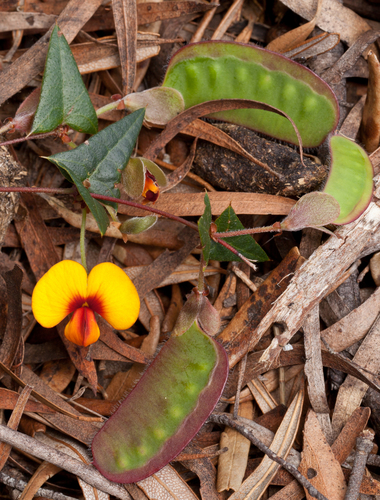
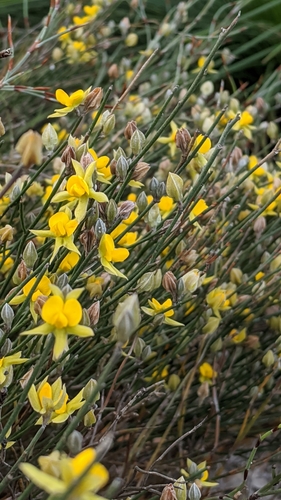
Jacksonia stackhousei F.Muell., commonly known as wallum dogwood, is a tufted, low-lying shrub. It typically reaches 0.2–2.5 m in height and 0.5–2 m in width. Its leaves are reduced to egg-shaped, dark brown scales that are 0.5–1.7 mm long, 0.6–1.2 mm wide, and have toothed edges. Flowers are scattered along branchlets or located at the ends of branchlets, and grow on pedicels 0.9–3.3 mm long. Egg-shaped bracteoles 1.2–1.7 mm long and 0.8–1 mm wide attach to the upper sections of the pedicels. The floral tube is 0.6–1.1 mm long and not ribbed. The sepals are membranous: upper sepals lobes are 2–5.5 mm long and 2.9–3.4 mm wide, lower sepals lobes are 5.8–6.0 mm long and 1.1–1.4 mm wide, and lower lobes are fused for 0.6–1.1 mm. The flowers are yellow with no markings. The standard petal is 4.2–4.5 mm long and 6.8–7.6 mm deep, the wing petals are 5.5–5.6 mm long, and the keel is 4.5–4.7 mm long. The stamens have red filaments that measure 2.5–5.3 mm long. Flowering takes place from May to November. The fruit is a sessile, oval pod up to 5 mm long that remains hidden inside the remains of the sepals. This species grows in coastal heath and woodland on white sand over sandstone, with a distribution ranging from Shoalwater Bay in south-eastern Queensland to near Wooli in northern New South Wales.