About Jacksonia dilatata Benth.
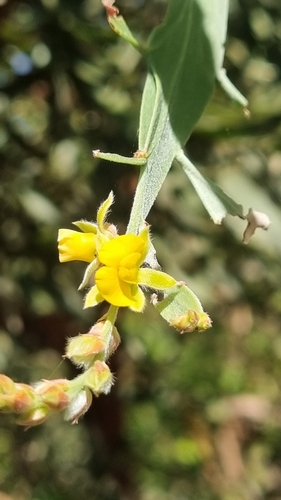
Jacksonia dilatata Benth. is most often a sturdy, erect shrub or tree that typically grows 1–5 m tall and 0.5–2 m wide, and rarely grows as a prostrate shrub. Its branches are greyish-green, with terminal phylloclades shaped from narrowly egg-shaped to narrowly elliptic or elliptic. These phylloclades measure 26–150 mm long and 4–20 mm wide. Its true leaves are reduced to reddish-brown, egg-shaped scales that are 0.7–2.8 mm long and 0.5–1 mm wide. Flowers are arranged in spike-like clusters of 8 to 20 at the tips of phylloclades. Each flower sits on a pedicel up to 0.7 mm long, and has broadly egg-shaped bracteoles 2.2–7.4 mm long and 1.4–2.7 mm wide. The floral tube is 0.7–1.5 mm long. The sepals are membraneous: the upper sepals lobes are 5.1–6.2 mm long and 1.9–2.0 mm wide, while the lower lobes are slightly longer and narrower. The flowers are yellow. The standard petal is 5.5–6.6 mm long and 8–9 mm wide, the wing petals are 4.4–4.8 mm long, and the keel petal is 3.7–3.8 mm long. The stamens have green filaments and measure 2.2–5.2 mm long. Flowering occurs across all months from April through February, and the fruit is a membraneous pod 4.7–5.9 mm long and 2.7–3.4 mm wide. This Jacksonia species commonly forms thickets in sandy soil on sandstone, and sometimes grows on beach dunes. It is mainly restricted to multiple bioregions of the Northern Territory including Arnhem Coast, Arnhem Plateau, Central Arnhem, Coolgardie, Daly Basin, Darwin Coastal, Gulf Coastal, Gulf Fall and Uplands, Gulf Plains, Ord Victoria Plain, Pine Creek, Sturt Plateau, Tiwi Cobourg, and Victoria Bonaparte. It also occurs in Queensland.