About Ixoreus naevius (Gmelin, 1789)
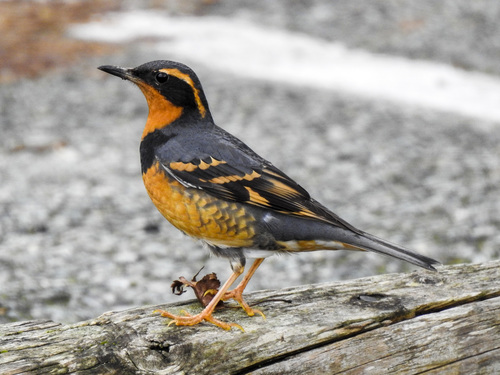
The varied thrush, scientifically named Ixoreus naevius (Gmelin, 1789), is a fairly large thrush species. Adults range from 20 to 26 cm (7.9 to 10.2 in) in total length, with a wingspan of 34 to 42 cm (13 to 17 in). Body mass varies between 65 to 100 g (2.3 to 3.5 oz). Standard measurements for the species are as follows: wing chord measures 11.8 to 13.6 cm (4.6 to 5.4 in), bill length measures 1.8 to 2.3 cm (0.71 to 0.91 in), and tarsus length measures 2.9 to 3.3 cm (1.1 to 1.3 in). It is similar in size to the widespread American robin, though varied thrushes are on average shorter with a heavier, more robust build overall. In general, varied thrushes have plumage with distinct intense orange and black feathers. Adult males have medium orange base plumage with a curved gray pattern on the breasts and throats, plus grayish-blue tail tips, scruffs, and crowns. They also have a tufted supraloral stripe and dark streaks on their flight feathers. Their bill is gray overall, but tan near the base of the lower jaw, and their legs are most often tawny or dark brown. Female varied thrushes have less well-defined markings, with more olive-brown and gray tones, brown hind feathers, and indistinct gray-brown plumage on the breast area. Juvenile varied thrushes are mostly brown overall, with white belly feathers, and initially have two orange stripes on their covert feathers. Varied thrush clutches most commonly contain 3 to 4 eggs per nest, but may have between 2 and 5 eggs. The eggs are pale blue with light brown spotting. Only the female incubates the eggs, and the incubation period is approximately 2 weeks. Both parent birds feed the nestlings. The development rate of young varied thrushes and the age at which they fledge from the nest are not well documented. It is thought that the species raises approximately 2 broods per year. An extremely rare plumage variant of this species exists, where all the orange plumage is replaced with white. The 1982 rare vagrant recorded in Britain was of this white variant, which has led to speculation that the mutation causing this color variation also impacts the thrush's navigational abilities. Only five sightings of this variant have been recorded since 1921. Varied thrushes breed in western North America, ranging from Alaska down to northern California. The species is migratory: northern breeding populations move south within or slightly beyond the species' breeding range, while other populations may only move altitudinally. This is an unlikely transatlantic vagrant, but there are currently two accepted western European records, both from Great Britain: one in 1982, and one on Papa Westray in the Orkney Islands in October 2021. The species builds nests in Alaska, Yukon Territory, and the mountain regions of Alberta, British Columbia, Washington, and Oregon. It prefers moist conifer forest habitat, and is most common in dense, older conifer forests at high elevations. In winter, varied thrushes move to lower elevations, where they are often found in towns, orchards, and thickets, or migrate further south to California. In winter, they form flocks of up to 20 individual birds. It is well documented that individual varied thrushes may fly eastward during winter, appearing in nearly any U.S. state, before returning to the west coast to breed.