About Isotoma fluviatilis (R.Br.) F.Muell. ex Benth.
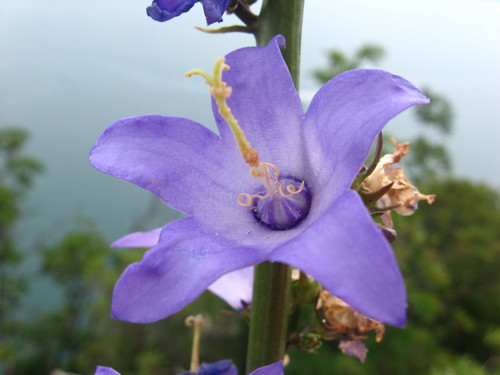
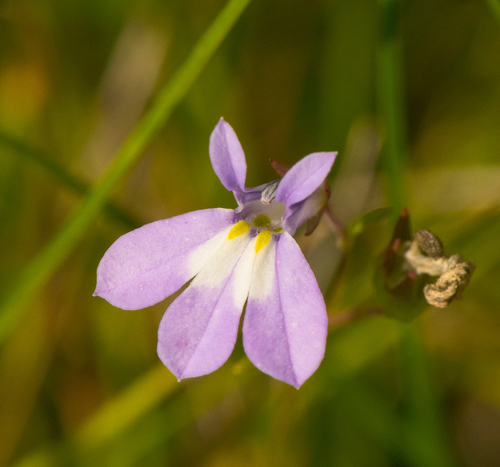
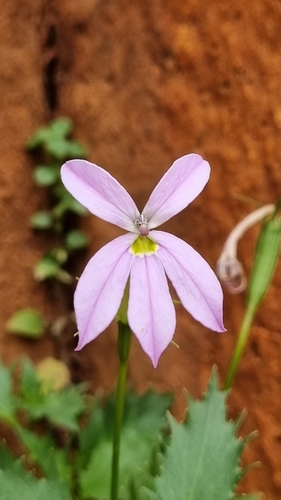
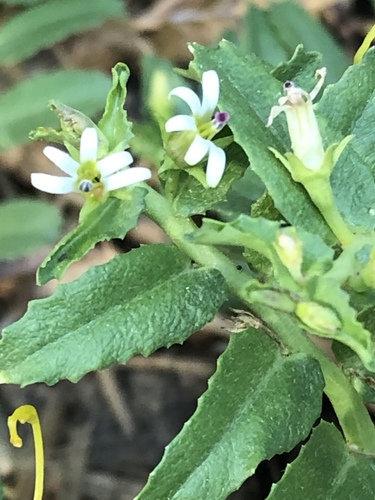
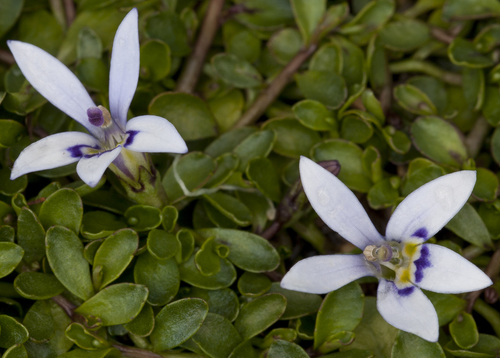
Isotoma fluviatilis (R.Br.) F.Muell. ex Benth. typically grows as a low, mat-forming plant. Most individuals are covered in fine hairs (pubescent), though some are hairless (glabrous), and they root at their stem nodes. The deep green leaves measure 4 to 12 millimetres (0.16 to 0.47 in) long and 2 to 8 mm (0.079 to 0.315 in) wide. Leaf blades are oblong, elliptic, or linear, while the plant's lower leaves may be ovate or obovate. It produces solitary white flowers that grow in leaf axils, and these flowers can be either bisexual or unisexual. After flowering, the plant forms obconical to obovoid, slightly asymmetric seed capsules. The capsules are usually 3 to 6 mm (0.118 to 0.236 in) long and have a diameter of 3 mm (0.118 in). Flowering occurs in summer, between November and March, and produces a carpet of white-blue five-petalled star-shaped flowers. This growth habit makes it ideal for use as groundcover in garden beds, rockeries, or between paving stones. I. fluviatilis grows best in dappled sunlight or part shade, and requires moist soil. It spreads through runners. In the United States, it is hardy in growing zones 6-8. In the United Kingdom, it is hardy in coastal and relatively mild areas, and is generally free of pests and diseases. In its natural range, the species is most often found growing on moist sand, in mud along creek and stream margins, in seepage areas, around granite outcrops, and in wet depressions. It is native to south eastern Australia, where its distribution extends from southern South Australia through most of Victoria, most of Tasmania, eastern New South Wales, and south eastern Queensland.