About Isopogon trilobus R.Br.
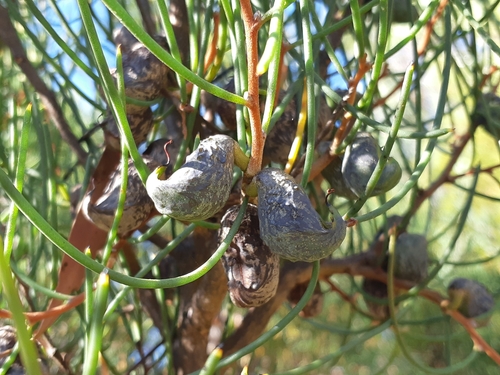
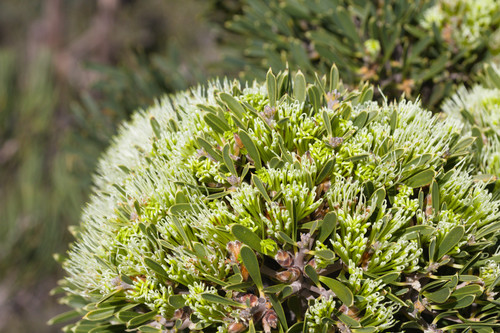
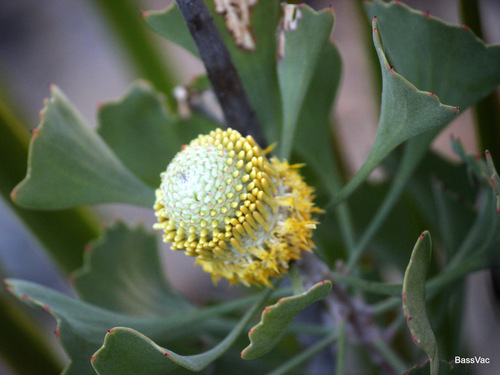
Isopogon trilobus R.Br. (common name barrel coneflower) grows as a shrub between 30 cm and 2 m in height. New stems range in colour from pale to reddish brown, and are initially covered in small fine hairs before becoming smooth with age. The leaves are 40–70 mm long, and feature three to nine teeth or three to five deep lobes; each tooth or lobe ends in a sharp point. Flowers grow at the ends of branchlets, arranged in sessile, oval, spherical or barrel-shaped heads that are 25–30 mm wide. Hairy, broadly egg-shaped involucral bracts are present at the base of these flower heads. The flowers themselves are covered in silky hairs, are cream-coloured to yellow, and measure 8–10 mm long. Flowering occurs between September and December. After flowering, the plant produces hairy oval nuts that fuse together into a barrel-shaped head around 28 mm in diameter. Barrel coneflower is widespread along the south coast of Western Australia, growing from the Stirling Range east to Israelite Bay. It occurs on sandplains, dunes or rocky outcrops, in sandy soils that sometimes sit over laterite, within heathland or shrubland communities. Two species of bee have been recorded visiting the flowerheads of Isopogon trilobus: the colletid bee Hylaeus sanguinipictus and the halictid bee Lasioglossum caesium. In horticulture, Isopogon trilobus is sensitive to Phytophthora cinnamomi dieback, and requires excellent drainage and full sun. It likely cannot tolerate humid climates. Grafting onto eastern Australian Isopogon species such as I. anethifolius or I. dawsonii can make the plant adaptable to a wider climatic range. The shrub has horticultural potential due to its dense growth habit and large fruit heads.