About Isopogon formosus R.Br.
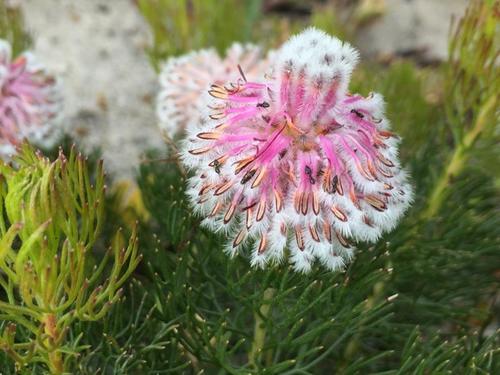
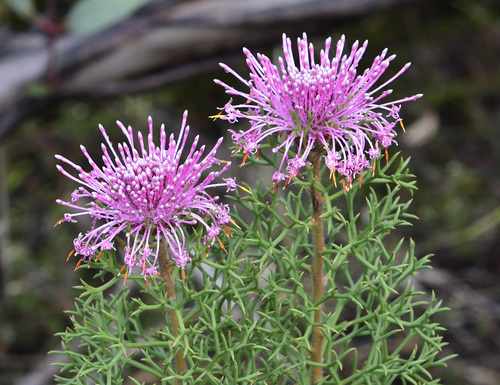
Isopogon formosus, commonly known as rose coneflower, is an erect or spreading shrub that typically grows 1.5–2 meters (4 feet 11 inches to 6 feet 7 inches) tall. It has pale to reddish brown young branchlets. Its leaves grow up to 35 millimeters (1.4 inches) long, attached to petioles up to 25 millimeters (0.98 inches) long. The leaves are divided into grooved cylindrical segments that end in a sharp point. Flowers form at the tips of branchlets or in upper leaf axils, growing in sessile, spherical to oval heads around 60 millimeters (2.4 inches) in diameter. Egg-shaped to lance-shaped involucral bracts sit at the base of these flower heads. The flowers themselves are red or mauve-pink and more or less hairless. After flowering, the plant produces hairy nuts that are fused together into a spherical or oval head up to 20 millimeters (0.79 inches) in diameter. This species grows across a variety of soils in swampy areas, rocky outcrops, and sandplains. Its main range in Western Australia falls between Bunbury and Esperance, within the Esperance Plains and Jarrah Forest biogeographic regions. The subspecies Isopogon formosus subsp. dasylepis occurs between Busselton, Noggerup, and the Scott River. The autonymous subspecies Isopogon formosus subsp. formosus grows in near-coastal areas between Walpole and Hopetoun, and from Dalyup to Cape Arid National Park. In horticulture, Isopogon formosus requires excellent drainage and full sun. It cannot tolerate extended periods of dryness or heavy frost.