About Isopogon anethifolius (Salisb.) Knight
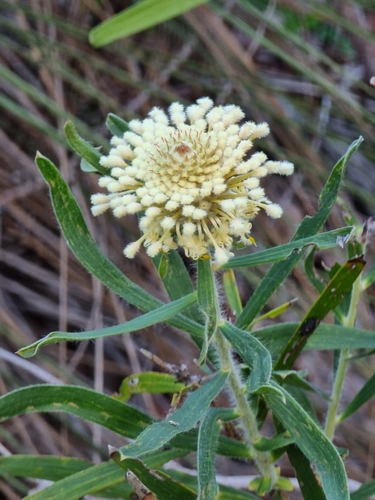
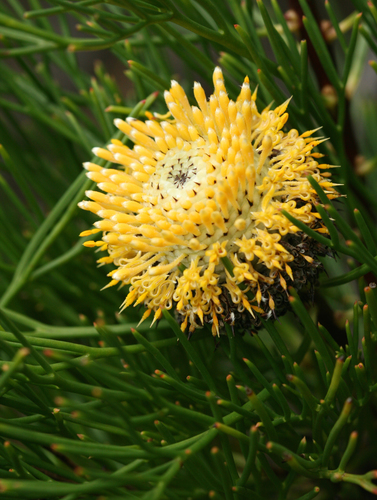
Isopogon anethifolius (Salisb.) Knight is an upright shrub, typically growing between 1 and 3 metres (3 to 10 feet) tall, with a tall, thin form made up of mostly vertical stems. It generally grows taller in more sheltered sites like woodlands, and stays shorter in more exposed areas. Its stems are reddish, and new winter growth has a reddish and tan tint. The leaves are round in cross section (terete), with a diameter less than 1 millimetre (1⁄25 inch). Over their maximum length of 16 centimetres (6+1⁄4 inches), the leaves branch once or twice. Globular yellow inflorescences (flowerheads) grow at the ends of branches in spring and early summer (September to December), and occasionally appear at other times of year. These flowerheads can reach up to 4 centimetres (1+1⁄2 inches) in diameter. Individual flowers grow in a spiral pattern from the central woody core of the flowerhead, and are around 1.2 centimetres (1⁄2 inch) long. They are straight, stalkless structures that arise from a scale on the core, and consist of a tubular structure called a perianth that encloses the flower's reproductive organs. The perianth splits into four segments, exposing a thin, delicate style that ends in a stigma. The male pollen-producing anthers are located at the tips of the four perianth segments. Arranged in a spiral, flowers open from the outer lower part of the flowerhead inward. After old flower parts fall away, egg-shaped grey cones are revealed; these can grow up to 2.5 centimetres (0.98 inch) in diameter. The seed-bearing nuts are small, reaching up to 4 millimetres (3⁄16 inch) across, and have a hairy lining. Each seed weighs approximately 4 milligrams (0.00014 ounce). The terete leaves, each less than 1 millimetre across, readily distinguish Isopogon anethifolius from other species in the genus, which have flat leaves wider than 1 millimetre. On a microscopic level, the supporting ground tissue of I. anethifolius differs from some other species in its genus due to its irregular misshapen sclereids (thick-walled cells that form part of the ground tissue) and contorted cell bodies. Isopogon anethifolius is found only in New South Wales, Australia, where it occurs in the Sydney Basin and surrounding areas, ranging from Braidwood northward to Mount Coricudgy in Wollemi National Park. Annual rainfall in these areas falls between 900 and 1,600 millimetres (35 to 63 inches). This species grows naturally from sea level up to 1,200 metres (3,900 feet) in altitude, and is found growing on sandstone in heathland and dry sclerophyll woodland. Common associated tree species include the scribbly gums Eucalyptus haemastoma and Eucalyptus sclerophylla, and silvertop ash (Eucalyptus sieberi). Common associated open forest plants include soft geebung (Persoonia mollis), and common associated heathland plants include heath banksia (Banksia ericifolia), dwarf she-oak (Allocasuarina nana) and Wingello grevillea (Grevillea molyneuxii). After bushfire, Isopogon anethifolius resprouts from its woody base, called a lignotuber. It is also serotinous: it holds seeds in a canopy-based seedbank on the plant, and releases the seeds after fire. Released seeds fall directly to the ground or are blown a short distance by wind. Plants that resprout from the lignotuber can flower in around two and a half years, while new seedlings take around three and a half years to flower. The fungus Vizella causes leaf spotting on this species, and weevils may damage its flower buds. Isopogon anethifolius was first cultivated in the United Kingdom in 1796. Along with Isopogon dawsonii, it is the easiest member of the genus to grow. Its fine foliage, red stems, bright yellow spring flowers, and distinctive post-flowering cones make it an attractive garden plant. It has potential use as a screening plant for privacy, thanks to its dense foliage. It prefers acidic soil with additional water, though it cannot tolerate waterlogged conditions. It grows best in a part-shaded position, but also grows readily in full sun. It can survive frosts as cold as −8 °C (20 °F). Applying fertiliser in spring supports its growth. Young plants may produce long, eventually drooping stems, and respond well to pruning. This species can be propagated from cuttings or seeds; seeds germinate 30 to 60 days after planting, and plants grown from seed take several years to flower. Western Australian Isopogon species including I. cuneatus and I. latifolius can be grafted onto rootstocks of I. anethifolius. The flowers, cones and foliage of this species are used in the cut-flower industry.