About Isopogon anemonifolius (Salisb.) Knight
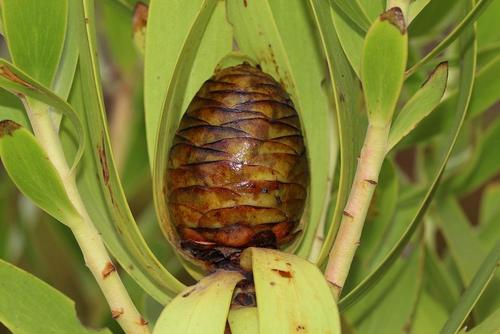
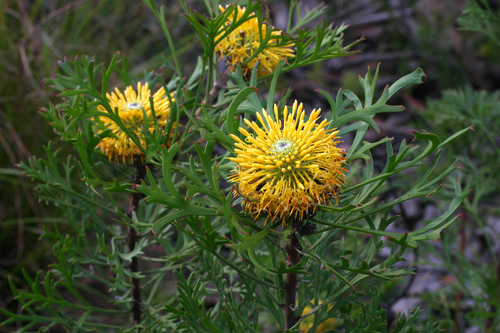
Isopogon anemonifolius is an evergreen, woody shrub that typically grows 1–1.5 m (3 1⁄4–5 ft) tall, reaching only around 50 cm (1 3⁄4 ft) when growing on exposed heaths and headlands. Its leaves are 5–11 cm (2–4 1⁄4 in) long; they fork into three segments after 2–5 cm (3⁄4–2 in), and often fork a second time, with pointed leaf tips. Leaf shape and size can vary a great deal even on a single plant, and some leaves remain undivided. Leaf surfaces are usually smooth, though they are sometimes covered in fine hair. I. anemonifolius can be distinguished from Isopogon anethifolius by its flat leaves, which are also broader; I. anemonifolius leaves are 3–5 mm (1⁄8–3⁄16 in) wide, compared to the 1 mm (1⁄25 in) wide terete (round in cross-section) leaves of I. anethifolius. New growth and young leaves of I. anemonifolius may have a red to purple flush, especially during winter. Globular inflorescences can appear any time between July and January, and are most abundant in October. The flowerheads are 3–4 cm (1 1⁄8–1 5⁄8 in) in diameter, growing at the terminal tips of branches, or occasionally axillary, arising from short stems off existing branches. Individual flowers average 1.2 cm (1⁄2 in) long, and are straight, stalkless structures that grow from a basal scale. The perianth, a tube that surrounds the flower's sexual organs, splits into four segments to reveal a thin, delicate style with a stigma at its tip. The male pollen-producing anthers are located at the ends of the four perianth segments. Flowers are arranged in a spiral pattern, and open from the bottom of the flowerhead inwards. After flowering, round fruiting cones develop, with a diameter of 1–1.6 cm (3⁄8–5⁄8 in). The seed-bearing nuts are small, measuring less than 4 mm (3⁄16 in) across, and lined with hairs. I. anemonifolius is found along the east coast of New South Wales, Australia, ranging from near the Victorian border almost to (and possibly reaching) Queensland. It is most common between Smoky Cape and Ulladulla, with an outlying population near Torrington in the New England region. It occurs naturally from sea level up to 1200 m (4000 ft), growing in low-nutrient sandstone soils in heathland and dry sclerophyll woodland, especially along hill ridges and hilltops. It is commonly associated with woodland trees including scribbly gums Eucalyptus haemastoma and Eucalyptus sclerophylla, yertchuk (Eucalyptus consideniana), yellow bloodwood (Corymbia eximia), red bloodwood (Corymbia gummifera) and smooth-barked apple (Angophora costata), and heathland plants including rusty banksia (Banksia oblongifolia), swamp banksia (Banksia paludosa), mountain devil (Lambertia formosa), conesticks (Petrophile pulchella), tick bush (Kunzea ambigua), forest oak (Allocasuarina torulosa) and Hakea laevipes. I. anemonifolius is a long-lived species with a 60-year lifespan. It resprouts from its woody basal lignotuber around two months after a bushfire. New growth takes two years to produce flowers, though older plants with larger lignotubers regrow more quickly. This species is slow-growing; a 1990 field study in Brisbane Water National Park found that the lignotuber grows at a rate of 0.173 cm per existing cm of lignotuber per year, resulting in a lignotuber roughly 1 cm (3⁄8 in) in diameter at 10 years of age, and 5 cm (2.0 in) in diameter at 20 years of age. The largest recorded lignotubers reach 40 cm (16 in) in diameter. Plants need a lignotuber at least 2 cm (3⁄4 in) in diameter to survive low-intensity fires, and plants only resprout after more intense fires once they reach 15 years of age. I. anemonifolius is also serotinous: seeds are held on the plant as a canopy-based seedbank, and are released after fire. Most seedlings emerge within a year of a bushfire, and very few are seen at other times. The seedbank is most productive between 25 and 35 years after a previous fire. However, I. anemonifolius seedlings can be outcompeted by seedlings of obligate seeder species. Seeds fall directly to the ground or are blown a short distance by wind. Young plants flower around seven years after germinating from seed. Repeated bushfires at intervals shorter than 10 years are likely to reduce survival of older plants and limit seedling recruitment, which may lead to local extinction within 50 years. Population stability requires intervals of at least 12–13 years between low-intensity fires, and at least 15 years between hotter fires. Leaf spotting in this species is caused by the fungus Vizella, and weevils may damage flower buds. I. anemonifolius was first cultivated in the United Kingdom in 1791, where Knight reported that it successfully flowered and set seed. With attractive foliage and prominently displayed flowers and cones, I. anemonifolius adapts well to cultivation. It can be grown in rock gardens, as border plantings, or as a potted plant. Garden-grown plants may vary in habit, growing either upright or spreading, and some naturally maintain a compact habit without requiring pruning. It grows easily in sandy, well-drained soil in full sun or part shade. The species is suited to USDA hardiness zones 9 to 11. It tolerates frosts and dry periods, but produces more flowers when given additional moisture. Once established, it can be heavily pruned. Propagation is done by seed, or by cuttings of hardened growth less than one year old. Seeds can be collected from cones and stored, and are best sown in spring or autumn. Stems and flowers of I. anemonifolius are long-lasting when placed in water, and its flowers, cones and foliage are used in the cut-flower industry. Isopogon 'Woorikee 2000' is a selected dwarf cultivar of I. anemonifolius, propagated by Bill Molyneux of Austraflora Nursery in Victoria, that produces abundant flowerheads. Plant Breeders Rights were granted for this cultivar in Australia in 1997, and it became commercially available in 1999. Another dwarf cultivar, 'Little Drumsticks', is also sold commercially.