About Isophysis tasmanica (Hook.) T.Moore
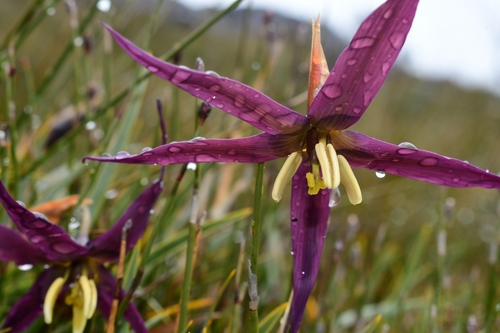
Isophysis tasmanica is a tufted plant that grows from a woody underground rhizome, and produces smooth, linear leaves. The leaves measure 5–30 cm long and 3–5 mm wide, and persist in fan-shaped arrangements. Its erect, terete, unbranched scape can reach up to 40 cm in height. One to three smaller leaves wrap around the stem along the length of the scape. Below the solitary terminal flower sits a pair of spathe bracts (modified leaves) that enclose the flower; these bracts are brown or purple. The flower itself is most often purple, sometimes ranging to almost black, and occasionally yellow. Its petals are equal in size, 2.5–6 cm long and 3–9 mm wide, and joined together to form a tube. This species has a superior ovary, along with three flattened stamens. The superior ovary is a feature that sets it apart from all other members of the Iridaceae family. Most members of Iridaceae have septal nectaries, nectar-producing tissue located in the ovary, but these structures are not present in Isophysis tasmanica. This absence suggests that Isophysis tasmanica does not produce nectar to attract pollinators. The former genus name Hewardia is still used as a place name in southwest Tasmania's wilderness. For example, Hewardia Ridge on Mt. Picton, located near Pineapple Flats, is named after this species, which is also called Pineapple Grass. Isophysis tasmanica is a dominant species in alpine sedgeland. It also grows in coniferous heathland, alpine heathland, bolster heathland, and deciduous heathland. It occurs at elevations from sea level up to 1300 m, in open-structured vegetation. It grows on highly siliceous rocks, and is most often found on gravel slopes or in rock crevices.