About Isolepis prolifera (Rottb.) R.Br.
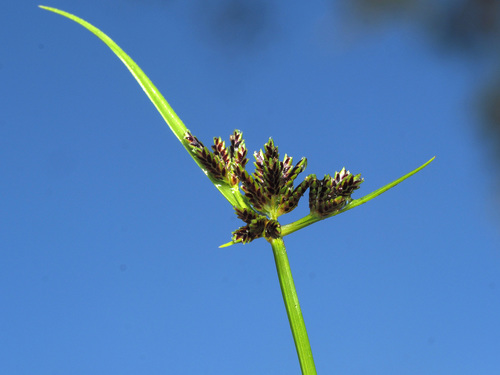
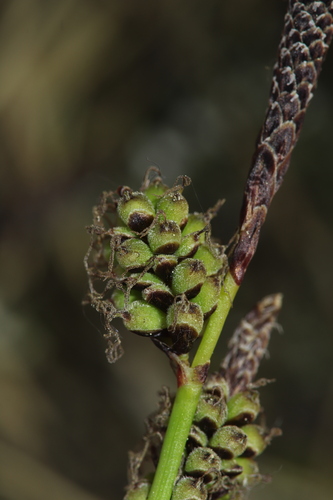
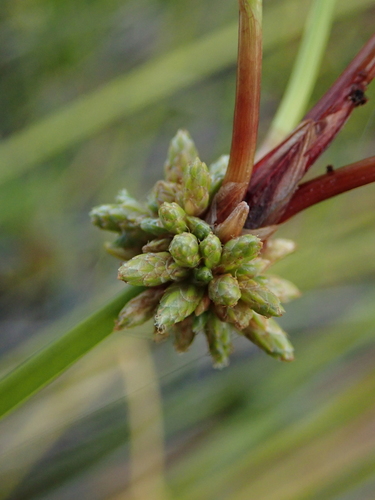
Isolepis prolifera (Rottb.) R.Br. has a caespitose (tufted) growth habit, with round stems that reach up to 90 centimetres (35 in) tall and 4 millimetres (0.16 in) wide. Its leaves are reduced to red or brown sheaths that wrap around the stem; sometimes these sheaths bear a small free lobe up to 3 mm (0.12 in) long. Its flowers are grouped into clusters of spikelets, which measure 2–10 mm (0.08–0.39 in) long and 1–2 mm (0.04–0.08 in) wide. However, many of these spikelets are replaced by branchlets, each 2–7 cm (0.8–2.8 in) long, that end in an additional cluster of spikelets. This repeated branching proliferation gives the species its scientific epithet prolifera. Each spikelet holds up to 30 flowers, and the fruit is a nutlet with fine reticulations across its surface. Isolepis prolifera varies a great deal in size, and smaller individuals can resemble the Australasian species Isolepis inundata. Unlike I. prolifera, I. inundata normally produces some true leaves and does not always show this proliferating growth. Isolepis prolifera occurs in multiple countries across the world, and it is unclear whether populations are native or introduced in most regions. The International Union for Conservation of Nature considers the species to be native only to South Africa, where it grows in the Eastern Cape, KwaZulu-Natal, and Western Cape provinces. It is also widespread across New Zealand, found on the North Island, South Island, and Chatham Islands, and may be native to this area. In Australia, I. prolifera is found in New South Wales, Victoria, Tasmania, and the Mediterranean-climate region of Western Australia. It is also possibly native to Tristan da Cunha and Saint Helena, and has been introduced to France and California. Isolepis prolifera is a perennial helophyte, meaning it is a marsh plant. It grows successfully in both eutrophic and oligotrophic wetlands, and can become a weed in farmland drainages.