About Ischyja manlia (Cramer, 1776)
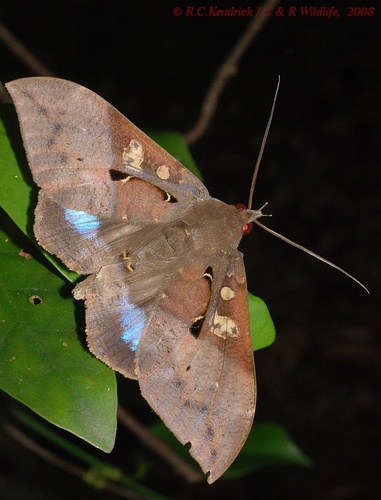
The wingspan of male Ischyja manlia ranges from 80 to 100 mm, while the wingspan of females ranges from 96 to 112 mm. In males, the head and thorax are red brown, and the abdomen is either fuscous or red brown. A white spot occurs at the base of the hind tibia, and additional white spots are present on the outer spur of the midlegs and the outer medial spur of the hindlegs. Forewings are pale red brown, dark red brown, or olive brown, and are irrorated (sprinkled) with dark specks. Traces of antemedial and medial waved lines are visible, along with a straight oblique postmedial line. The orbicular and reniform spots are either greyish or ochreous, or take the form of deep black quadrate spots with white edges. Black spots are generally present below the center and end of the cell; these spots have a white lunule on them and are conjoined by a streak. Sometimes, a large ochreous patch is present from the lower end of the cell to the inner margin. An obscure waved sub-marginal line starts as an oblique streak from the apex. Hindwings are very dark red brown. The area near the anal angle is greyish with dark strigae. A broad, irregularly angled, purplish-blue medial band runs from the costa to vein 2. Above the anal angle, there is a black spot with a pale streak on it. On the ventral side, the forewing has a white irregular postmedial band that extends from the costa to vein 2, and the hindwing has a dentate postmedial line. In females, the forewings are much more uniform in colour and lack black patches. The oblique line is prominent, the hindwing's band is broader and more regular, and there is no mark above the anal angle. Female colouration is often very dark. Larvae are purplish brown and ochreous, with irregular short black streaks across their bodies. Their heads are ochreous with brown speckles. Short dorsal conical prominences are present on the 4th to 6th somites, and on the 10th and 11th somites. The pupa is efflorescent.