About Ischnura verticalis (Say, 1840)
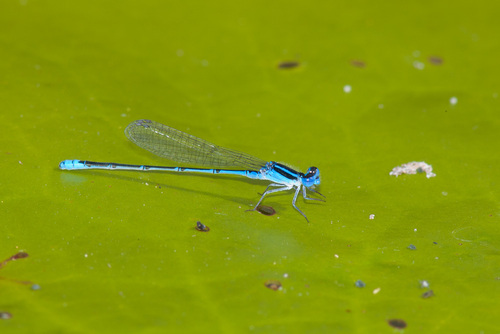
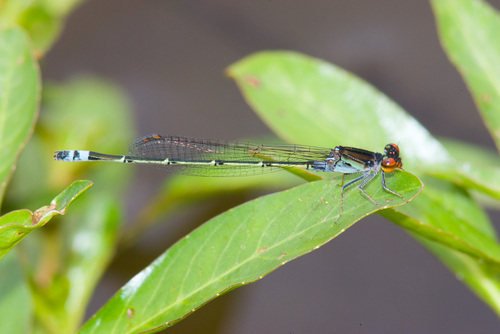
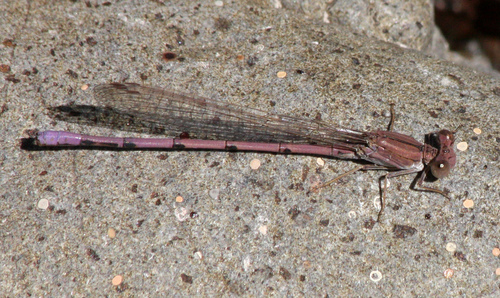
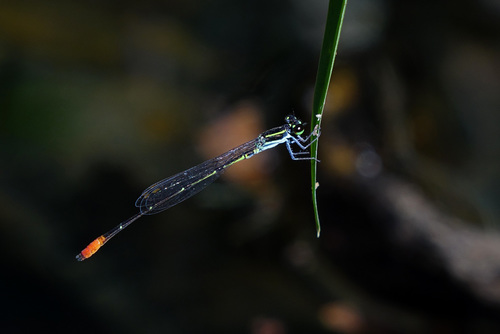
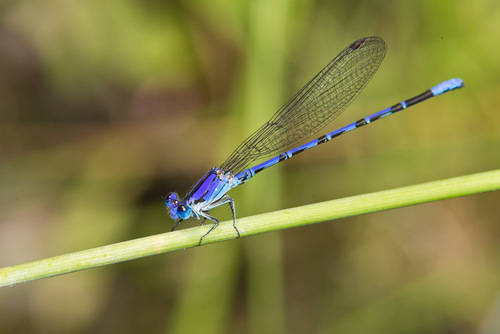
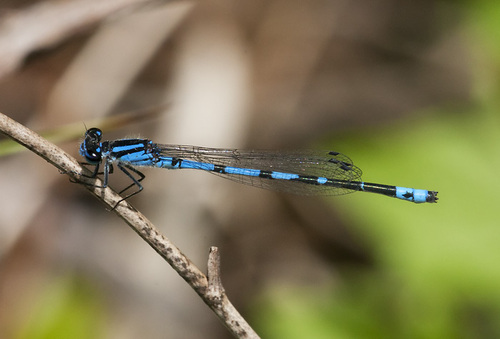
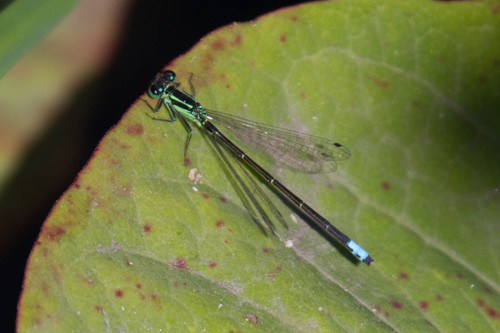
Ischnura verticalis (Say, 1840) is a small damselfly species that reaches a body length of 22–30 millimetres, or 0.87–1.18 inches. Individuals have slender bodies, with four wings that fold over the back, and base coloration in shades of green, black, and blue.
Male Ischnura verticalis have a black upper thorax, with pale green sides and green shoulder stripes. Their eyes are dark on top and greenish below. The abdomen is mainly black, marked with thin pale rings. The top of the abdomen, on the eighth and ninth abdominal segments, is blue, with black markings on the sides. Males have tiny projections extending from the tip of the abdomen, which gives the species its specific name. Most females are grayish-blue, with grayish markings on the abdomen. Immature females have a bright orange thorax with black dorsal and shoulder stripes, a black upper abdomen and orange lower abdomen, and eyes that are dark above and orange below. In both mature and immature females, the pterostigma ranges from white to light brown. Less commonly, females can be yellow-green, matching the coloration of males. This species is very similar to Ischnura perparva, the Western Forktail; the two species are most easily distinguished by their different ranges.
Ischnura verticalis is found in the eastern United States, ranging from the Atlantic coast to the Midwest, north of Florida into southern Canada, and west as far as Montana and New Mexico. These damselflies live in a variety of wetland habitats, most commonly small ponds, slow-moving streams, and marshes.