About Ischalis fortinata (Guenée, 1868)
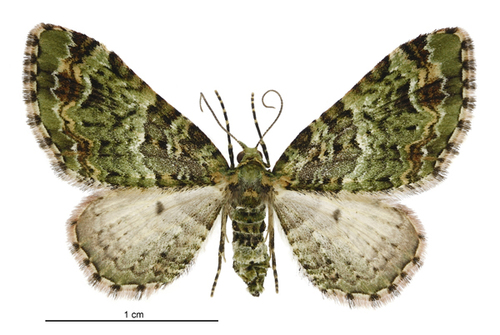
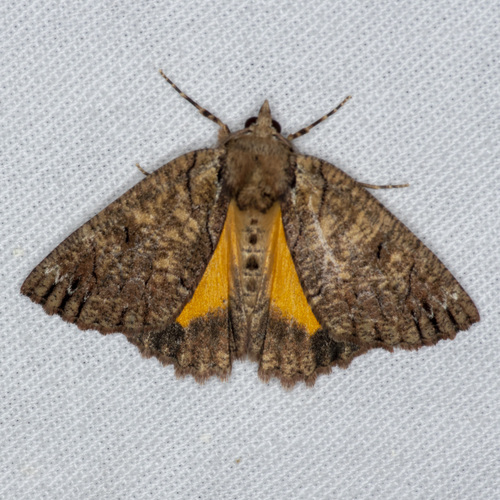
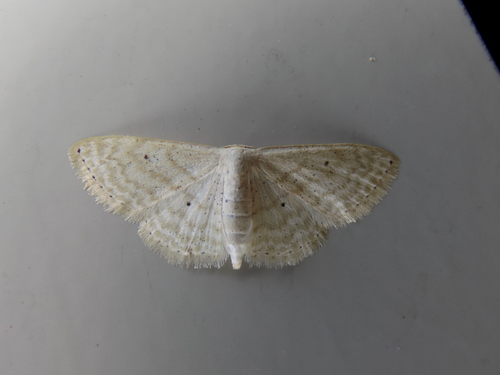
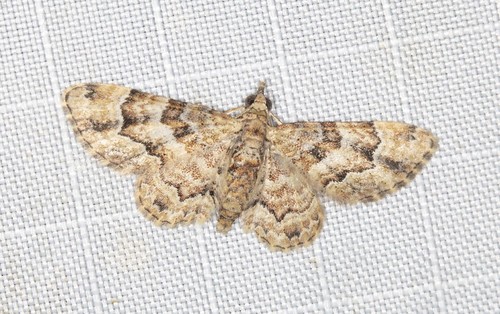
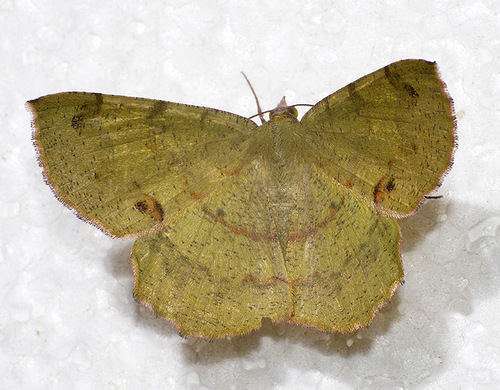
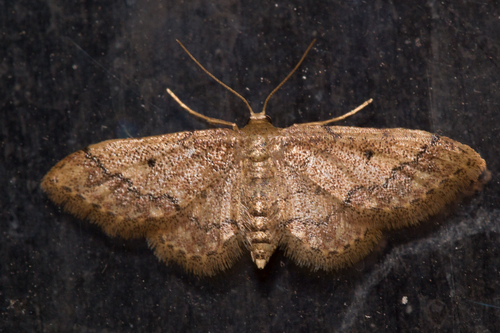
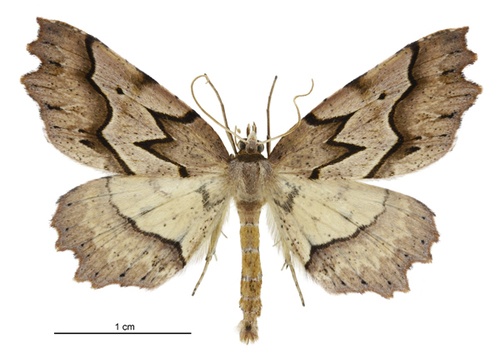
The larva of Ischalis fortinata was described by Hudson as follows. Immediately after its first moult, the young larva is around 1⁄8 inch long. It is dull ochreous, with a prominent blackish dorsal line, three or four fine, bright red lateral lines, and an additional blackish line below the spiracles. The head is pale ochreous dotted with black, and the entire larva is covered with rather long black hairs. The mature larva of this species is reddish-brown with greenish-reddish mottling, has a hairy texture, and measures between 25 and 30 mm in length. A brown line with black edges runs along the larva’s back, and several segments have a number of black and white markings. Guenée described the adults of this species as follows. This attractive Phalenite is a very unusual species, with wings shaped in a completely unique way. Each forewing has two triangular notches at the apex, the first of which is very deep; each hindwing also has two notches near the middle. The wings are testaceous-yellow, more or less tinged with violet, and marked with two distinct, deep black median lines. The first line forms two very sharp angles above and below the median nervure; the second line also forms two matching angles, but these are more open and blunter, and the second line is paler along its inner edge. Between the two lines, there is a brown mark on the costa, with a black dot just below it. Opposite the second angle of the elbowed line, there are two more black dots, and there are additional black markings near the terminal excision. Hindwings have only one line, which fades away near the middle of the wing. In clearly marked specimens, all wings also have a pale subterminal line. The underside of the wings is a brighter yellow, heavily marked with ferruginous, and displays the same lines and dots as the upper side, but these markings are less distinct and reddish. On the hindwing underside there is a median band that is toothed along its lower edge, topped in the cellule by an oval ferruginous dot. This dot is crossed by a fine white line that splits the cellule in two and extends to the apical margin. The entire body shares the same colouration as the wings. This species is endemic to New Zealand. It has been recorded on both the North and South Islands, and is abundant in native forest in the far south of the South Island. It inhabits native forest. Its recorded larval host plants are Polystichum vestitum and Polystichum richardii, and the larvae feed throughout the year.