About Iris uniflora Pall. ex Link
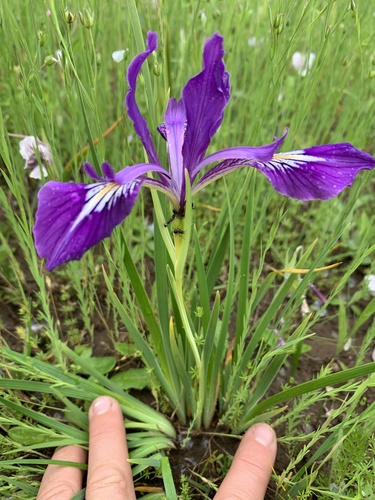
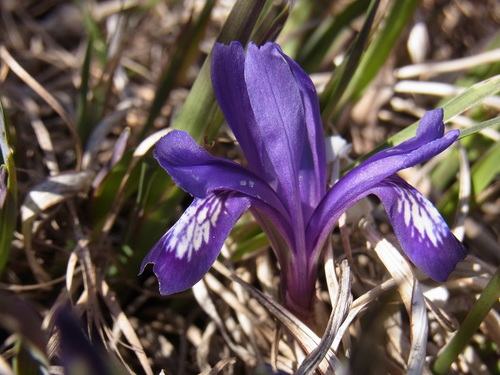
Iris uniflora Pall. ex Link differs from Iris ruthenica by having thick, resilient bracts (bracts are specialized leaves on the flower stem where a flower emerges) that stay green or yellow-green until seeds mature. On Iris ruthenica, the bracts usually dry out and die after flowering finishes. It has a thin, creeping, brown, branched rhizome covered with the remains of the previous year’s leaves, and also produces fibrous roots. Its slender flowering stems reach up to 15 cm long and are occasionally branched. It has thin, grass-like, linear and lanceolate leaves; 2 to 3 green leaves grow from the plant’s base, measuring 10 to 40 cm long and 5 to 10 mm wide. After the blooming period ends, the leaves grow longer than the flowering stems. It blooms between May and June, normally producing one flower, occasionally two, that carry a violet-like fragrance. Its perianth tube measures about 1.5 cm long. Flowers come in shades of purple ranging from blue-purple to violet, and are 4 to 4.5 cm in diameter. They have a white, veined or striped signal at the base of the flower’s fall. It has 1.5 cm long stamens and a 5 mm long ovary. It sets fruit between July and August, after the blooming period. It produces oval to globose seed capsules that measure 8 to 10 mm in diameter, which are un-ribbed, a trait that distinguishes this species from other irises. Inside the capsules are round, black seeds that each have a small fleshy appendage. Iris uniflora is native to temperate regions of Asia. It can be found in Central Asia (including Transylvania), Russia (including Siberia, Primorye and Transbaikalia), Mongolia, Tibet, Korea, and China (including Heilongjiang, Jilin, Liaoning, Manchuria and Qinghai). It grows on grasslands (steppes), along forest margins, in deciduous woods, on hillsides and mountain slopes, and has been recorded in Quercus forests in the Amur region of Russia. In cultivation, it grows well in garden borders, but only produces flowers in dry, sunny positions. It is stable in culture and can overwinter without shelter. It is suitable for rocky hills, curb plantings, and group plantings in southern forest-steppe and steppe regions. Compared to Iris ruthenica, Iris uniflora is more strongly confined to dry soils. It has been tested in cultivation in Moscow, Khabarovsk, and Vladivostok, and is held as a specimen in 7 botanical garden collections around the world. In east Siberia, the aphid Aphis neonewtoni (Pashtshenko) occurs on the upper surfaces of Iris uniflora leaves. In Tibetan herbal medicine, its seeds are used as an ingredient in remedies for detoxification and as an insecticide. Its flowers are used to treat eyesight problems, and its root is used to cure freckles and ringworm.