About Iris tenuifolia Pall.
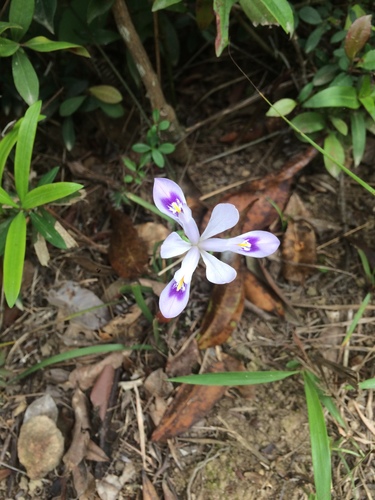
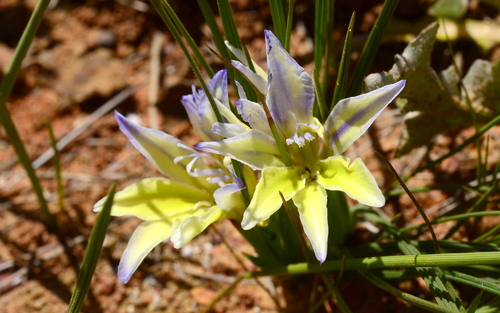
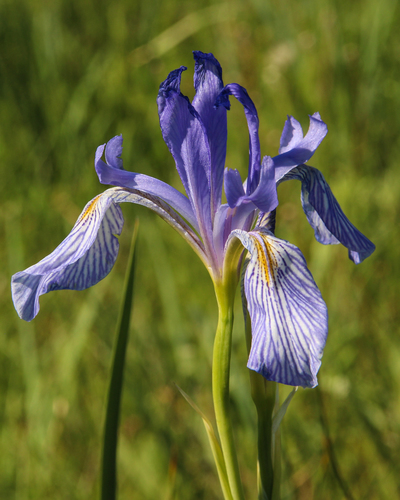
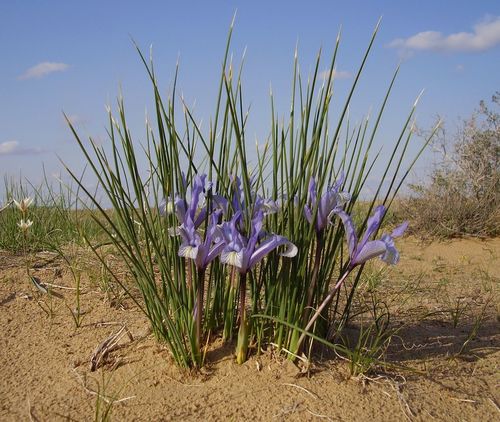
Iris tenuifolia Pall. is very similar in form to the Mediterranean Iris unguicularis, as both have very short stems, and their seed capsules are often hidden within the plant's leaves. It has dark brown, thin, short, knobbly, tough, wood-like rhizomes, with a network of fibrous roots growing underneath the rhizomes. At the base of the leaves, on top of the rhizome, are brown or red-brown fibrous remains of leaves from previous seasons. These remains act as sheaths for new leaves, and the sheaths can grow up to 6–20 cm (2–8 in) long. The plant can grow as a single individual or form thick clumps. It has greyish-green, linear, twisted leaves that grow between 20–60 cm (8–24 in) long and 1.5–2 mm wide. The leaves have parallel veins rather than a single mid-vein, end in a pointed tip (are acuminate), continue growing after blooming, and eventually form a mass of twisted leaves. The leaves are longer than the plant's flowering stems. It has a very short flowering stem (or scape) that is 10–30 cm (4–12 in) long, and sometimes the stems do not emerge above ground at all. It has 2 to 4 pointed (acuminate), membranous, green spathes (flower bud leaves) that are 5–10 cm (2–4 in) long and 8–10 mm wide. Stems normally hold 1–3 terminal (top-of-stem) flowers, which bloom in spring between April and May, or as late as early June in Russia. The flowers are scented, 4–7 cm (2–3 in) in diameter, and come in shades of pale violet, lilac, pale blue, or purple. It has two pairs of petals: three large outer sepals called 'falls', and three smaller inner petals (or tepals) called 'standards'. The falls are spoon-shaped (spatulate) or obovate-lanceolate, 4.5–6 cm long and 1.5 cm (1 in) wide. They have a thin central yellow crest or mid-vein, dark veins on a pale background, and a band of small papillose hairs. The narrower, oblanceolate, erect standards are 5 cm (2 in) long and 5–9 mm wide. It has a long, slender, thread-like perianth tube that is 4.5–8 cm (2–3 in) long. It has three solid-colored style branches that are 4 cm (2 in) long and 4–5 mm wide; the branches narrow slightly (attenuate) and have toothed tips. It has a slender 3–4 mm long pedicel, 3 cm (1 in) long stamens, and a cylindric ovary that is 7–12 cm (3–5 in) long and 2 mm wide. After flowering, between late July and early August in Russia, or between August and September in China, it produces an ovoid or sub-globose seed capsule that is 3.2–4.5 cm (1–2 in) long and 1.2–1.8 cm (0–1 in) wide. The capsule has a short beak-like appendage on the top. The seeds are oval or top-shaped (turbinate), wrinkled, and range in color from black-brown to brown. The seed capsule is often hidden by the plant's long leaves. Iris tenuifolia is native to a wide range of temperate areas across Central Asia, extending from the Volga region through Turkestan into Mongolia and China. It is found in the western Asian countries of Afghanistan and Pakistan, and in the central Asian regions of Kazakhstan, Uzbekistan, and Mongolia (former Soviet Union republics). It is also found in multiple regions of Russia, including Agin-Buryat Okrug, Bashkortostan, Chelyabinsk, Chita, and Siberia. Alongside Iris bloudowii, Iris humilis, Iris ruthenica, Iris sibirica, and Iris tigridia, it is found in the Altai-Sayan region, where Russia, China, Mongolia, and Kazakhstan meet. In China, it occurs in central regions, specifically the provinces of Gansu, Hebei, Heilongjiang, Jilin, Liaoning, Nei Mongol, Ningxia, Qinghai, Shanxi, Xinjiang, and Xizang; one source also lists Shandong. While some sources mention Turkey or Iran as part of its range, most do not, so these occurrences are not considered valid. It grows in semi-desert, desert, and mild mountainous areas, including on sandy steppes, dunes, alongside sandy riverine grasslands and river banks, on dry coastal sand regions, on gravelly desert-like slopes, and in rock crevices. It grows at altitudes between 1000 and 4200m above sea level. In northeast China, it is found growing on poor soils on open, treeless plains. Iris tenuifolia is rare in cultivation in both the UK and the US, and is mostly grown by specialized collectors or for scientific and research purposes. In the 1800s, it was sometimes treated as an annual plant and only planted during the summer in the UK. It is hardy when grown in a northern continental climate, similar to that of Nebraska, North Dakota, or South Dakota, and is hardy in parts of Russia; it has been successfully grown in Moscow, St Petersburg, and Chita. It prefers sandy or sandy loam soils, matching its native desert habitat, and prefers alkaline soils and positions in full sun. It needs to be kept dry during winter, and requires the protection of bulb frames when grown in the UK. It only needs water during its growing period. The plant loses all its foliage in winter, when foliage is removed by wind, snow, and other bad weather, and re-grows new leaves in April and May. It has high tolerance for drought and heat, similar to desert conditions. In 2001, a study was conducted to assess the effects of Iris tenuifolia as part of a herbal remedy for kidney protection. The Iris genus has been used in traditional folk medicine to treat a variety of conditions, including cancer, inflammation, and bacterial and viral infections. Compounds isolated from Iris germanica have been found to have anti-tumor, anti-oxidation, anti-malarial, and anti-tuberculosis effects, among other positive effects. The roots, seeds, and flowers of irises are used as ingredients in herbal medicines, and have been used for tocolysis (anti-contraction medication for labor) and to treat fetal metrorrhagia. On 24 December 2009, a patent was granted for the extraction of Iris tenuifolia, because its chemical compounds are used in the treatment of Alzheimer's disease.