About Iris tectorum Maxim.
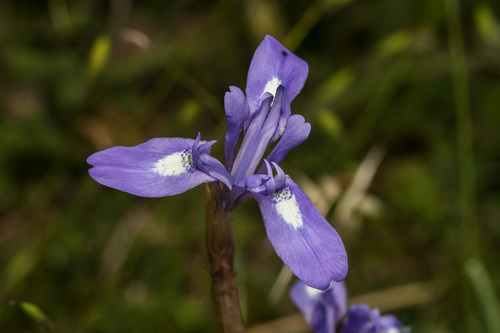
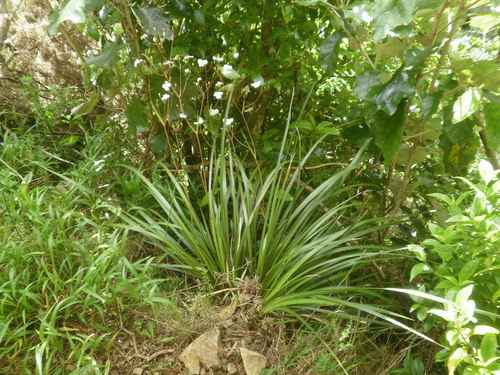
Iris tectorum Maxim. has a thick creeping rhizome that is roughly the size of a man’s thumb, and is colored buff or greenish. Its rhizomes are similar in shape to those of bearded irises. Below the rhizome are short, slender roots, while fibers grow from the top of the rhizome. Its creeping growth habit forms spreading clumps of plants, and it does not produce stolons. This iris produces basal fans of yellowish green to pale green leaves; the leaves are sword-shaped (ensiform) or lance-shaped, glossy, ribbed, floppy, and semi-evergreen. Leaves grow 15–60 cm (6–24 in) long and 1.5–5 cm (1–2 in) wide. It has cylindrical (terete) stems that reach 20–45 cm (8–18 in) in height, with 1–2 branches and 1–2 reduced stem leaves. Stems hold 2–3 green, lanceolate flower bud leaves (spathes) that are 3.5–7.5 cm (1–3 in) long and 2–2.5 cm (1–1 in) wide. The flower stalk (pedicel) is 1 cm long, shorter than the spathe, and similar in size to the ovary. Stems and branches hold 1 to 3 flowers, which bloom in late spring to early summer, between April and May or June; in Australia, it blooms between September and October. The flower display lasts 2 weeks. Flowers are 7.6–10 cm (3–4 in) in diameter, flattened and horizontal, and larger than the flowers of Iris japonica. Flower colors range from lavender blue, bluish violet, blue-lilac, purple-blue, or sky blue, and a white-flowered form also exists. There are 2 pairs of flower parts: 3 large outer sepals called falls, and 3 smaller inner petals (or tepals) called standards. The falls are obovate (egg-like) or ovate, with darker brownish purple/violet mottling, veining, streaks, or spots around a toothed or fringed (laciniate) white crest. The bicolored claw (the part of the petal closest to the stem) is white and violet or lilac. Falls are 5–7 cm (2–3 in) long and 4 cm wide. The elliptic standards spread horizontally (not upright), and are 4.5–5 cm (2–2 in) long and 3 cm wide. Both falls and standards can have wavy margins. Flowers are self-fertile and pollinated by insects. It has a slender perianth tube 2.5–3 cm long, stamens 2.5 cm long with bright yellow anthers, and a cylindrical ovary 1.8–2 cm long. The pale bluish-violet style branch is 3.5 cm long, with irregular toothed lobes at its tips. After flowering, between June and August, it produces an ellipsoid or obovoid (oblong-ovoid) light green seed capsule that is 4.5–6 cm (2–2 in) long and 2–2.5 cm wide, with 6 ribs. When the capsule ripens and turns brown, it splits into three parts along 2 or more seams starting from the top. Inside are multiple black-brown pear-shaped (pyriform) seeds, each with a small cream-colored appendage (aril). This species is native to temperate and tropical regions of Asia. It is found in central and southwestern China, within the provinces of Anhui, Fujian, Gansu, Guangdong, Guangxi, Guizhou, Hainan, Hubei, Hunan, Jiangsu, Jiangxi, Shaanxi, Shanxi, Sichuan, Xizang, Yunnan and Zhejiang. It is also found in Korea and the tropical region of Myanmar (Burma). It is often listed as native to Japan, but may only be naturalized there. It has naturalized in Bhutan, India, and regions of America including New Hampshire. It grows on forest margins, sunny banks, meadows, damp places, beside water, along roadsides, and on steep hillsides within China, at altitudes between 500–3,500 m (1,600–11,500 ft) above sea level. In New Hampshire, it grows wild on the edges of lawns and fields, beside roadsides, and in compost heaps. Like many other irises, most parts of the plant (rhizome and leaves) are poisonous. If mistakenly ingested, it can cause stomach pains and vomiting. Handling the plant may also cause skin irritation such as dermatitis or an allergic reaction. Cultivation of Iris tectorum is very similar to cultivation of Iris japonica and Iris milesii. It is hardy in USDA Zones 4 through 9, and in European Zone H2, meaning it can tolerate temperatures as low as −10 °C, but needs protection from hard frosts. Older plants can survive some frosts, but young plants need spring protection. Both blue and white forms are fully hardy. It is hardy in the UK, but does not flower very well because British summers are not hot enough to bake the plant's roots. After flowering, it is best to remove old stems from Iris confusa, Iris japonica and Iris tectorum, as this helps the plant survive winter. It prefers to grow in humus-rich, moist soil with good drainage. During spring or autumn, a top dressing of well-rotted compost or well-rotted manure should be added; fertilizer can also be added. A mulch can be applied at the same time to retain moisture. It tolerates neutral or acidic soils with pH levels between 6.1 and 7.8. It can grow in positions from full sun to partial shade, but prefers light shade; in full sun, its leaves can bleach, similar to how leaves grow in woodland conditions. A small number of sources note it prefers a sunny, sheltered site. It has average water needs during the growing season. If summer becomes exceedingly hot and dry, the iris will enter early dormancy. It therefore prefers a dry, cold winter, and a warm, wet summer. It can be grown in mixed flower borders, rock gardens, and woodland gardens. If grown in a rockery, it is recommended to give the plant new soil or fertilizer every year. It can also be grown in containers and large 15 cm pots, but needs to be re-potted frequently. In the UK, potted plants can survive winter in a cold greenhouse. It suffers from a virus disease that causes leaf discolouration, yellowing and streaking. It appears immune to most insect pests, but can be damaged by slugs or snails. The aphid Aulacorthum solani can also be found on the plant. Because the roots can quickly deplete soil of nutrients, the plant needs division and re-planting every other year, or every 3 to 5 years when clumps become overcrowded. It can be left undisturbed for many years, but flowering will decrease. Like most rhizomatous irises, it should be planted with the top of the rhizome just at the soil surface, and spaced 20–30 cm (8–12 in) apart. Despite its toxicity, it is used in Chinese herbal medicine to treat hepatitis and wind damp pains. The Kam people feed fish fresh Iris tectorum as a medicine to treat stomach aches.