About Iris suaveolens Boiss. & Reut.
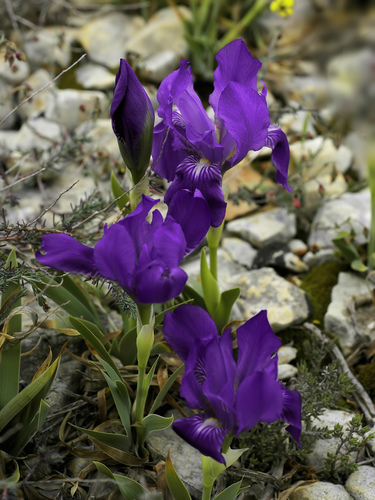
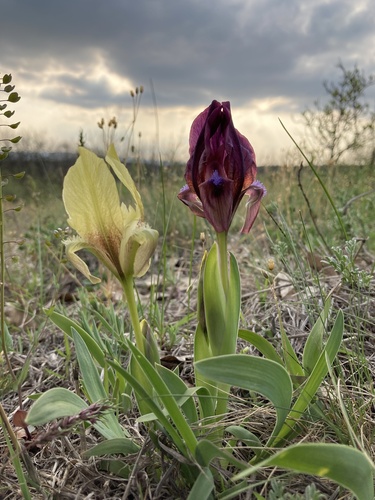
Iris suaveolens Boiss. & Reut. is similar in form to Iris attica, Iris reichenbachii, Iris lutescens, and Iris pumila. It has thick, small rhizomes that are around 1–2 cm long. It produces evergreen, falcate (sickle-shaped) or curved leaves; these short blue-green or greyish leaves grow between 7 and 22 cm (3 and 9 in) long, and 0.4 and 1 cm wide. One cultivar form of the species, known as 'rubromarginata', has red-violet or reddish purple edging on its leaves. As a dwarf iris, it has a slender, simple stem (peduncle) that grows between 8 and 15 cm (3 and 6 in) tall. Flowers on the stem are held above the foliage. The stem bears two green, lanceolate, keeled spathes (flower bud leaves) that are 2.5–8 cm (1–3 in) long, and remain green after the flowers fade. The stem produces between 1 and 2 terminal (top of stem) flowers in spring, blooming between late March and mid-April, or between March and May. The fragrant flowers are 4.5–5.5 cm in diameter, and come in various shades between yellow and purple, with yellow being the most common. Other flower colour shades include yellow-green, white, cream, violet-blue, smoky brown, mahogany, and purplish-brown, and bi-coloured forms also exist. Yellow forms can sometimes have brown-purple spots on their petals. Like other irises, it has two pairs of petals: three large outer sepals called 'falls', and three smaller inner petals (or tepals) called 'standards'. The obovate or cuneate falls curl under themselves and flare outwards, and are 3–5.5 cm (1–2 in) long. In the middle of the falls is a row of short hairs called the 'beard', which is white, orange, or yellow on yellow-flowered forms, and normally bluish or white with blue tips for other forms. The upright standards are shorter and wider than the falls. The perianth tube is about the same length as the style branch, measuring 5–7.6 cm (2–3 in) long. The seed capsule contains reddish brown, sub-globose seeds. This species is found in Europe, within the Balkan countries of Bulgaria, Romania, former Yugoslavia (including Albania and Macedonia), and Greece. It is also found in Turkey, and was listed as an endemic in the Red book of Bulgaria. It grows on open dry, rocky limestone hillsides, amid light scrub and scattered juniper trees. Like many other irises, most parts of the plant (rhizome and leaves) are poisonous. If ingested, it can cause stomach pains and vomiting, and handling the plant may cause skin irritation or an allergic reaction. It can be cultivated in the same conditions as Iris pumila. It is hardy between USDA Zone 6 and Zone 10. In the UK, it is not hardy and needs protection from wind and rain over winter, in a frame, alpine house, porch, or conservatory. In the US, it can grow in Vail, Colorado and Portland, Oregon. It prefers to grow in well drained, dry, rich soils, but can also tolerate poor soils. It grows best in neutral to alkaline soils, with a pH between 6.1 and 7.8. It prefers growing positions in full sun, or partial shade. It should be watered regularly, but not overwatered, as overwatering can cause the rhizome to rot in winter. It can be at risk from leaf spots, rot or botrytis, and may be attacked by thrips, sawfly, aphids, slugs, or snails. It can be grown in rock gardens or alpine troughs. Iris bulbs should be planted on the soil surface in summer, just above the substrate, normally with 30 cm of spacing between plants. This species can be used as an expectorant, as a diuretic, and for the treatment of children's dentition.