About Iris speculatrix Hance
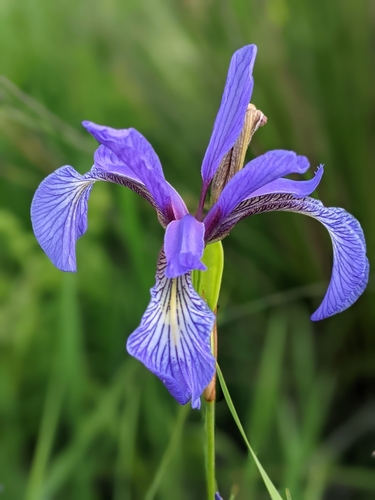
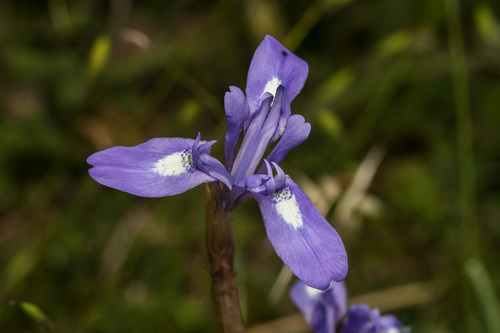
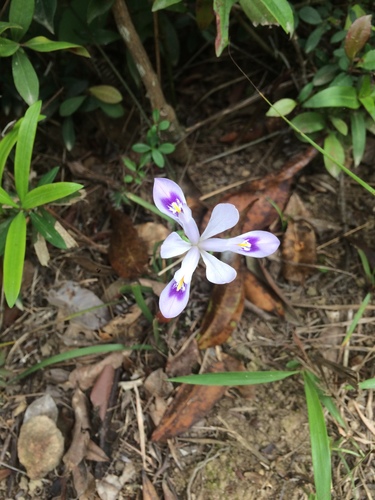
Iris speculatrix Hance has a creeping, thick, short brown rhizome. It produces glossy, linear, lanceolate (grass-like), dark green leaves that are 8–40 cm (3–16 in) long and 0.4–1.2 cm wide. Near the rhizome, leaves are covered in a sheath-like layer of fibres; they also have veining that is sometimes criss-crossed, and the species is sometimes considered evergreen. It grows long slender flowering stems that reach 12 to 35 cm (5 and 14 in) tall, normally falling in the 20–25 cm (8–10 in) range. These stems are the tallest of any iris species in the Chinenses Series. The stems bear 1–2 leaves, and between 1 and 2 terminal flowers (at the top of the stem) that bloom in spring and summer, between May and June. It has 2 or 3 green, lanceolate (lance-like) acuminate (point-tipped) spathes (flower bud leaves) that measure 5.5–7.5 cm (2–3 in) long. Flowers come in a range of blue shades, from violet, lilac, lavender, to light blue, and measure 5.6 to 6 cm in diameter, similar in size to Iris cristata. It has 2 pairs of petals: 3 large outer sepals called 'falls', and 3 smaller inner petals or tepals called 'standards'. The falls are spoon-shaped (spatulate), 3–4 cm (1–2 in) long and 0.9–1.3 cm wide, with a distinctive white central signal area speckled with purple, surrounded by a dark purple area, and a bright yellow or orange central crest. The standards match the falls in colour, are erect, oblanceolate, 3–3.7 cm long and 0.9–1 cm wide. The species has a 3–7 cm long pedicel, a 5 mm long perianth tube, and a solid beak beneath the tube. It also has 1.2 cm stamens with white anthers, a 1.6–2 cm long, 0.5 mm wide ovary, and 2.5 cm long, 7 mm wide style branches that match petal colour. After flowering, between July and August, it produces an ellipsoid seed capsule 5–5.5 cm long and 2 cm in diameter. The capsule has a long beak (acute point) at the top, and bends at a 90-degree (right) angle from the stem. Inside the capsule are dark brown, angled seeds with an aril that resembles a pale brown wing. Iris speculatrix is native to temperate areas of Asia. It is found across many provinces of China, including Anhui, Fujian, Guangdong, Guangxi, Guizhou, Henan, Hubei, Hunan, Jiangsu, Jiangxi, Qinghai, Shaanxi, Shanxi, Sichuan, Xizang, Yunnan and Zhejiang. It is also found in Hong Kong (at Cape D'Aguilar, Tai Tam, Sunset Peak, Po Toi Island, Shek O, Stanley on Lantao Island) and Taiwan. It grows beside forest margins, in open grassy groves, beside roadsides, and on mountain slopes. In Hong Kong, it can also be found growing on Violet Hill among bamboo, and it occurs at altitudes of 500–1,800 metres (1,600–5,900 ft) above sea level. It is hardy to H5, a rating meaning it tolerates temperatures down to 0 to −5°C, and is hardy to USDA Zone 6, though it may prefer Zones 7 – 9. In cooler locations outside these zones, it may require protection in a heated greenhouse, and it is considered tender (needing protection) in the UK. It prefers well drained soils with a pH between 5.0 and 6.0, and can tolerate sandy loam soils. It grows best in full sun positions but can also tolerate light to moderate shade. It is partially drought tolerant, and can be grown in containers or plant pots. It is rare in cultivation in Europe, the UK and the US. A 2014 study of Iris speculatrix populations in Hangzhou, China found the population-level flowering period lasted approximately 35 days from May to June, with most plants blooming between 8 May and 20 May. Individual plants have a flowering window of 3–6 days, and a single flower lives for approximately 3 days. Specimens of both Iris proantha and Iris speculatrix can be seen in Hangzhou Botanical Garden.