About Iris songarica Schrenk ex Fisch. & C.A.Mey.
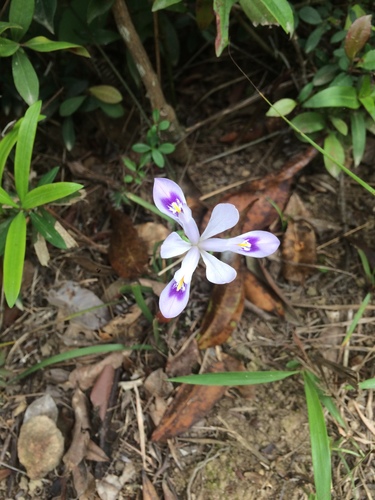
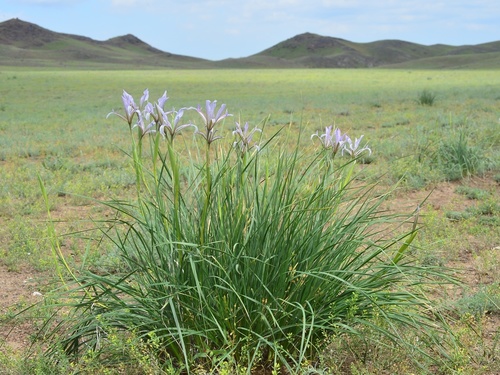
Iris songarica Schrenk ex Fisch. & C.A.Mey. has flowers that are similar in shape to Iris spuria, but differ in color shades. It has a slender, knobbly, dark rhizome. Under the rhizome, filamentous feeder roots can grow 1–1.5 m deep into soil, and extend 20–80 cm outwards. On top of the rhizome, maroon-brown fiber remains of last season's leaves interweave into a spiral effect, and form a sheath surrounding the base of new leaves. It has rigid, strap-like, linear, greyish-green leaves that are 15–23 cm long and 2–3 mm wide at flowering time; after flowering, leaves grow to 70–80 cm long and 7-10 mm wide, with a visible longitudinal vein. The round-in-cross-section (terete) flowering stem reaches 25–50 cm long, and is often longer than the leaves. It has 3 pointed (acuminate), green spathes (flower bud leaves) that measure 7–14 cm long and 1.8–2 cm wide. Stems normally hold 2–3 terminal (top of stem) flowers, rarely 3–5, that bloom in spring between June and July. Multi-flowering specimens were originally named Iris songarica var. multiflora, but this name is now classified as a synonym. The funnel-shaped flowers are 8–9 cm in diameter, and come in shades of violet, dark blue, to lavender blue. It has two pairs of floral parts: 3 large outer sepals called 'falls', and 3 smaller inner petals (or tepals) called 'standards'. The falls are fiddle-shaped, 5–5.5 cm long and 1 cm wide, with an ovate or elliptic tip limb, and bear violet or purple spots or blotches. The oblanceolate, erect standards are 3.5 cm long and 5 mm wide, and can also have darker veining, spots or blotches. It has a 4–6 cm long perianth tube, 4.5 cm long pedicel, 2.5 cm long ovary, and 2.5 cm long stamens, with linear, reddish-brown anthers. The style branches are 3.5 cm long and 1 cm wide, similar in size to the standards but a different color shade. It has 2-lobed stigmas with triangular teeth and purple filaments. After flowering, it produces an ovoid to cylindric, sometimes oblong, seed capsule 4–6.5 cm long and 1.5–2 cm wide in mid to late summer: between May and June in Central Asia, or August and September in China. The capsule is leather-like, veined, has a long beak-like appendage at the top, and can hold up to 20 seeds. The seeds are maroon-brown to dark brown, pear-shaped (pyriform) or elliptical, wrinkled (rugose), with a hard coating and a basal hilum. Iris songarica is native to a wide range of temperate areas across Central Asia, ranging from Iran (Persia) to Tibet. It is found in western Asia in Afghanistan, Pakistan, and Iran (including Gonabad). In Central Asia, it is found in the former Soviet Union republics of Kazakhstan, Tajikistan, Turkmenistan, and Uzbekistan, within Turkestan's Kopet Dag mountain range. It is also found in Mongolia and northern China. In 2010, a study of infiltration rates in an arid ecosystem in Yazd Province, central Iran, included Iris songarica among the sampled plant species, alongside Artemiaia sieberi, Astragalus achrochlarus, Astragalus candolleanus, Stachys inflate, Lactuca glaucifolia, Poa sinaica, Stipa barbata, and Agropyron desertorum. Its habitat includes clay desert steppes, desert areas, sunny grasslands, dry meadows, and stony or grassy hillsides. Iris songarica is not common in cultivation in the UK or Europe, and is only grown by collectors or for research purposes. It prefers sandy, well-drained alkaline soils, but can also grow on loamy, sandy gritty, and gravelly soils. It grows best in full sun positions, and needs to be kept dry during winter (and autumn if a very wet season is forecast), requiring protection from a bulb frame or similar structure. It only needs water during the growing season. In June 1886, a specimen of Iris songarica collected by C. Kuntze from the deserts of Turkmenistan was donated to The William and Lynda Steere Herbarium of the New York Botanical Garden. The aphid Dysaphis tulipae can be found living on this plant. In China, multiple studies have been conducted on this plant, which is classified as a herb for its medicinal antioxidant properties. In Afghanistan and Pakistan, ground root powder mixed with curd is used as a herbal remedy to treat diarrhoea. In Russia, the fibrous leaf sheaths that sit on top of the rhizome surrounding new leaves are used to make brush bristles. In Uzbekistan, sheep eat the seed capsules, and some shepherds consider the plant to be poisonous. Dry leaves are often harvested for use as litter or dry bedding for cattle in barns. It is sometimes considered an invader that covers large arid areas or abandoned dry, nutrient-poor fields. Its leaves contain 18% protein, 16% fibre, 12% fat, and a large amount of alkaloids. Its roots have been used in traditional medicine to treat toothache and childhood diseases, and have also been used in the cosmetic industry.