About Iris sintenisii Janka
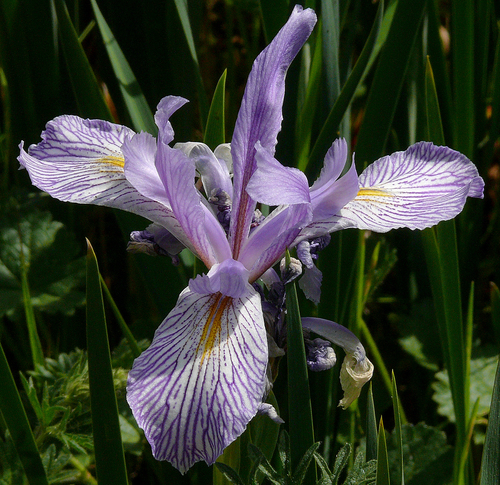
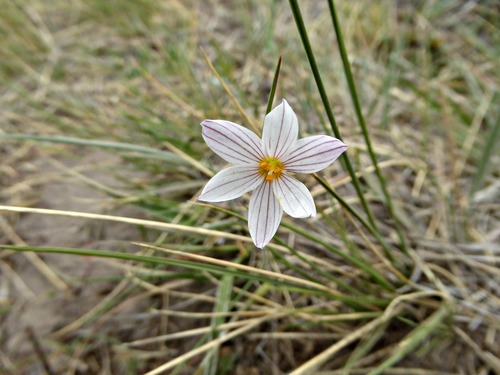
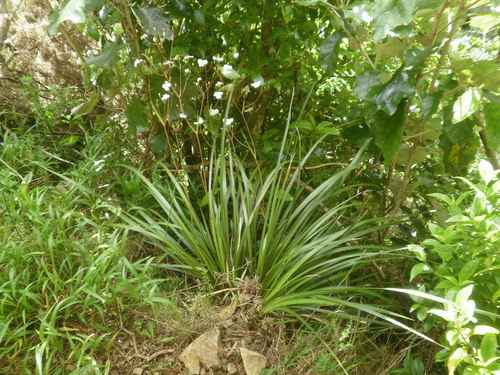
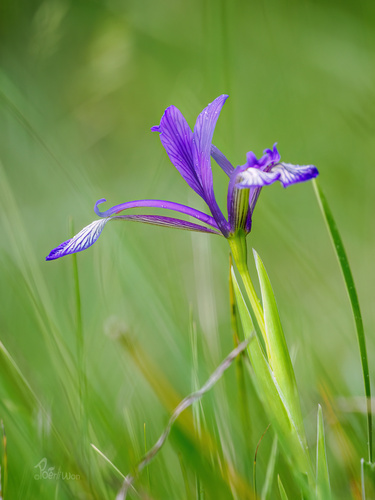
Iris sintenisii Janka has an appearance and form intermediate between Iris graminea and a small form of Iris spuria. It has thin, wiry, short rhizomes that are covered by the brown, fibrous remains of previous season's leaves. Over time, it produces many branches to form tight clumps or tussocks. It has linear, rigid, acuminate (tapering to a long point), grass-like leaves that range from glaucous green to dark green. These leaves are often described as evergreen, with distinct, prominent veins. They grow 10–50 cm (4–20 in) long and 0.3–0.5 cm wide, and they commonly grow taller than the plant's flower stems. Iris sintenisii is smaller than Iris graminea. Its stems are cylindrical or slightly compressed, unbranched, and reach 10–40 cm (4–16 in) in length. The stems bear 2–3 green, keeled spathes (flower bud leaves) that are 3.5–7.5 cm long; the inner spathes are slightly longer than the outer ones. The stems (or peduncles) hold 1 or 2 terminal flowers that bloom between late spring and summer, from June to July. The flowers are similar in shape to those of Iris graminea but differ in color, they are not scented, and reach 5–6 cm in diameter. Flowers come in shades of violet-blue, blue-purple, blue, purple, and violet. Like other irises, it has 2 pairs of petals: 3 large outer sepals called 'falls' and 3 smaller inner petals (or tepals) called 'standards'. The slender falls are slightly fiddle-shaped (panduriform), with a rounded or ovate/elliptic blade 1.3–1.4 cm long and 0.9–1.3 cm wide. The blade narrows into a long oval haft (the section connecting to the stem) that is 2.5–3 cm long and 0.3–0.5 cm wide. The haft is veined with red-purple, and the falls are white or cream, heavily marked with violet-blue or purple veining. The upright, solid-colored (violet-blue to blue-purple) standards are oblanceolate, 3–4 cm long and 0.4–0.5 cm wide. The solid-colored (violet-blue to blue-purple) style branches are 2.6–2.8 cm long and 0.5–0.6 cm wide, with recurved lobes. It has a small slender ovary 1–2 cm long with a slender beak, and small triangular crests. This iris is uniquely pollinated by ants, because its flowers secrete nectar at the base of the petals. After flowering, it produces an oblong seed capsule 1.5 cm long and 1 cm wide, with a slender beak appendage up to 2 cm long. Iris sintenisii is native to temperate regions of Asia Minor, eastern Europe, and southeastern Europe. Its range includes Turkey (Asia Minor), Albania, Bulgaria, Romania, parts of former Yugoslavia, southwestern Russian Federation, and North Macedonia. One source notes occurrences in France and Ukraine, but these populations are possibly naturalized. In the wild, it grows in dry grass meadows (including steppes), scrubland, and forest edges, at altitudes between 900 and 1500 m above sea level. It can be hard to spot in meadows after flowering, because its leaves look very similar to grass. Like many other irises, most parts of the plant (rhizome and leaves) are poisonous. Accidental ingestion can cause stomach pain and vomiting, and handling the plant may lead to skin irritation or an allergic reaction. It is hardy from USDA Zone 5a (−28.8 °C (−20 °F)) to USDA Zone 9b (−3.8 °C (25 °F)), and corresponds to European Zone H2. It can tolerate temperatures as low as −18 °C. It is hardy in the UK; within Russia, it is not hardy in St Petersburg, but thrives in the Stavropol Botanical Garden. It prefers to grow in well-drained soils that do not dry out over summer. Its shallow roots do not tolerate intense summer heat, which dries out the soil. It can tolerate soils that contain limestone, and grows in neutral to alkaline soils with a pH between 6.6 and 8.5. It grows well in positions with full sun or partial shade. During the summer growing season, the iris needs plenty of moisture to produce blooms, but care must be taken to avoid overwatering. It can be grown in rock gardens, at the front of flower borders, or in trough or sink gardens using large disused old sinks. Extra care is required when weeding in autumn and early spring, because the plant's leaves are very similar to grass.