About Iris scariosa Willd. ex Link
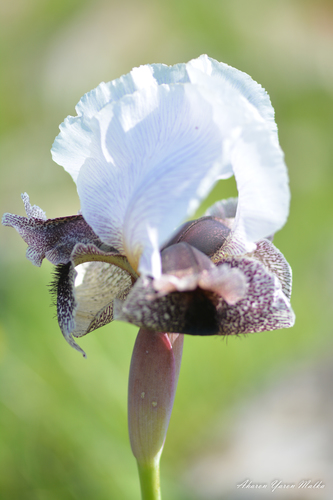
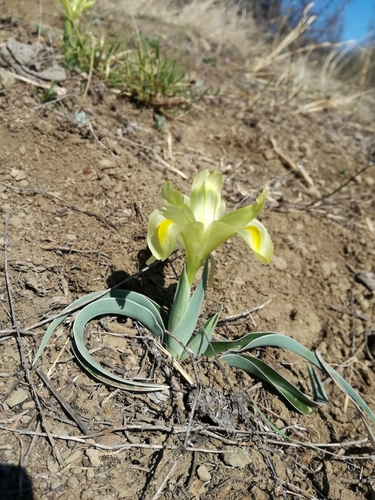
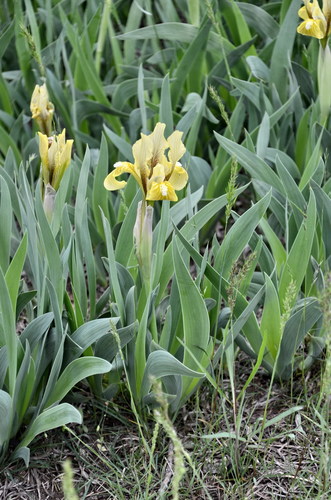
Iris scariosa Willd. ex Link is similar in form to Iris pumila. It has a yellow-white, thick, fleshy rhizome between 1.2 and 2.2 cm (0 and 1 in) in diameter. Secondary stolon-like roots grow under the rhizome, and yellow-white fibrous remains of last season's leaves sit on top of the rhizome. The ground-covering rhizomes grow in a creeping habit that forms small tufts of plants. It produces ensiform (sword-shaped), sub-lanceolate, or falcate (sickle-shaped) leaves that are blue-grey or grey-green. Leaves grow between 10 and 18 cm (4 and 7 in) long and 1 to 1.8 cm wide, and are generally longer than the flowering stem. The leafless flowering stem (or peduncle) can grow up to between 10 and 20 cm (4 and 8 in) tall, and normally reaches 15 cm (6 in) tall. The stem holds 3 or 4 thin, lanceolate spathes (flower bud leaves) that are scarious (membranous) and semi-transparent. The spathes are 4–6 cm long, 1.5–2 cm wide, and have reddish purple or lilac margins. It has a short brown-purple perianth tube about 1.5–4 cm long that is slightly flared upward, and also has short flower stalks (pedicels). Stems hold 2 terminal (top of stem) flowers that bloom in mid to late spring, between April and May, or in May, or between May and June. The unscented flowers are 3.5–5.5 cm (1–2 in) in diameter, and come in shades of violet, reddish violet, lilac, blue-purple, or blue. Rare near white or yellow flower forms have been reported, though these may actually be Iris glaucescens. Like other irises, it has 2 pairs of petals: 3 large outer sepals called 'falls' and 3 smaller inner petals (or tepals) called 'standards'. The falls are oblong or obovate shaped with a narrow claw (the section near the stem), and are 4.5–6 cm long and 1.5 cm wide. In the centre of each fall is a yellow hair 'beard', though this can sometimes be white on the wide blade section of the petal. The erect, oblanceolate shaped standards are 3.5–5 cm (1–2 in) long and 0.5 cm wide. It has 1.8 cm long stamens, a 1.5–2.8 cm long fusiform (spindle-shaped) ovary, and a lavender or pale purple style branch that is 3.5 cm long. After flowering, between mid to late summer (June to August, or June to July), it produces an ovoid, cylindrical spindle, or oblong shaped seed capsule. The capsule is 5–7.5 cm (2–3 in) long and 2.5–3 cm in diameter, with 6 visible veins or ribs. This loculicidal (compartmented) capsule holds dark brown, round or elongated seeds that are 4–5.5 mm long and 2–3 mm wide. This species is native to temperate central Asia and eastern Europe (specifically Russia). It can be found in Russia (Kalmykia, Bashkortostan, and Siberia), Kazakhstan, Mongolia, and China (Xinjiang province). Its distribution stretches from the Ural Mountains (above the Caspian Sea, including along the Volta River) eastwards to the Tien Shan Mountains and Altai Mountain range. In Kazakhstan, it grows on the Sugaty Plateau of the Ketmen Mountains alongside Tulipa iliensis. In China, it is found on the Tarbagatai Mountains and Maili mountains, alongside Fritillaria yuminensis, Paeonia hybrida Pall., Corydalis nobilis Pers., Primula veris L. subsp. macrocalyx (Bunge), Glaucium squamigerum Kar. & Kir., and Chelidonium majus L. var grandiflorum Willd. It grows on alkaline, dry, sunny, open stony hillsides, beside ditches, and in desert-like steppes, at altitudes between 1,500–2,400 m (4,900–7,900 ft) above sea level. Like many other irises, most parts of this plant (especially the rhizome and leaves) are poisonous. Accidental ingestion can cause stomach pains and vomiting, and handling the plant may trigger skin irritation or an allergic reaction. It is hardy to Zone H2 in Europe, meaning it tolerates temperatures between −15 and −20 °C (5 to −4 °F). Its cold hardiness has been tested in Russian botanical gardens in Moscow, Stavrapole, and St. Petersburg, and it was only found to be cold resistant in Stavrapole. It was first introduced to the Moscow Botanical Garden of Academy of Sciences in 1946, where it showed unstable growth: it does not bloom or fruit annually, and suffers damage over winter. It prefers to grow in well-drained soils in full sun. It does not tolerate waterlogged soils, which can damage its rhizomes, but it has high drought and salt tolerance. It can be grown in rock gardens, and is only collected and cultivated by iris specialists. It is cultivated in botanical gardens in Almaty, Barnaul, Jezkazgan, Karaganda, Kyiv, Saint Petersburg, Moscow, Omsk and Dovzhansk. In China, the rhizome of Iris scariosa is used to treat swollen gums, inflammatory pain, sore throat (or chronic pharyngitis), and hoarseness. The rhizome is ground into powder and then mixed with honey for use.