About Iris ruthenica Ker Gawl.
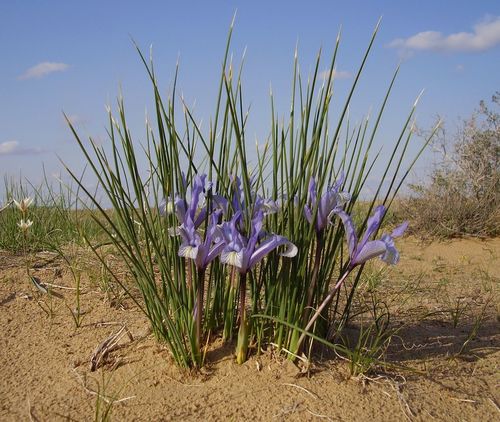
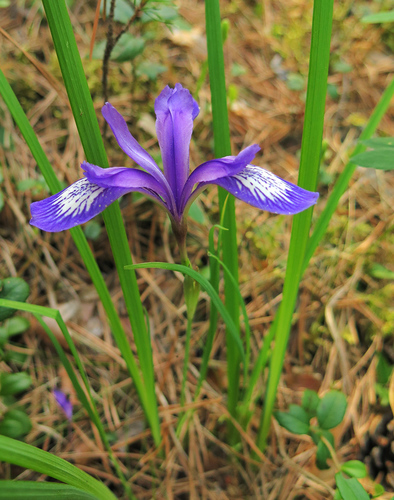
Iris ruthenica Ker Gawl. is a highly variable species of iris, and its hybrids can closely resemble Iris uniflora, the only other species in the Iris series Ruthenicae. This species varies widely in leaf length, leaf width, and flower height. It has a branched, creeping rhizome that is about 3–5 mm in diameter, and produces fibrous roots. The creeping rhizome allows the plant to form clumps or grass-like tufts. It bears bright green or greyish green, tall, thin, grass-like leaves that measure 10–40 cm long and 2–6 mm wide, and the leaves often grow longer than the flower stem. The entire plant, including stem and flowers, reaches a height of 3–20 cm. The thick stem reaches 3–20 cm in height and is 2–3 cm wide, and retains the remains of last year’s leaves at its base. It blooms in spring, which falls between May, June and July in the UK, or in early to mid-summer. It normally produces one fragrant, large flower, but occasionally bears two. The flowers are 3–5 cm in diameter, and have a cylindrical perianth tube that is 0.5–1.5 cm long. Flowers come in a range of blue shades from violet to bluish lavender, marked with violet veining. Like other irises, it has two pairs of petals: three large outer petals (sepals) called ‘falls’, and three smaller inner petals (or tepals) called ‘standards’. The falls, which measure 4.5–5 cm, are white. The standards, which measure 4–6 cm, are almost erect. The 3–5 cm long bracts are greenish with pink margins, the stigma is violet blue, and the anthers are milky white. After flowering, between June and August, it produces a globose ovoid-shaped seed capsule that measures 1.2—1.5 cm. When the capsules ripen, they fully open and release all their seeds in a single event, which is different from most other iris species. The seeds are pear-shaped (pyriform) and have a white appendage called an aril on the seed edge; the aril shrivels and disappears soon after release. Iris ruthenica is native to a wide area covering temperate Asia and Europe. In Asia, it occurs from southern Russia and Siberia, through Central Asia including the Altai Mountains, Turkestan, the Tien Shen mountain range, Kazakhstan and Mongolia, extending to China and Korea. In Europe, it is only found in Romania. It is recorded as one of several iris species found in the Altai-Sayan region, where Russia, China, Mongolia and Kazakhstan meet, alongside Iris bloudowii, Iris humilis, Iris lactea, Iris sibirica, Iris tenuifolia and Iris tigridia. It grows in dry meadows including grass plains and steppes, along pine and birch forest edges, at woodland edges, and in forest clearings within the forest-meadow mountain belt, where it forms thicket ground cover. In Mongolia, it grows under Pinus sylvestris/Betula platyphylla subtaiga forests, in montane meadow steppes with Festuca lenensis and Artemisia sericea, and in Pinus sibirica/Picea obovata dark taiga forests in the upper montane belt with Rubus saxatilis and Lathyrus humilis. Elsewhere in Eurasia, it grows in the larch forests of the Altai and Sayan mountains including Tuva, and occurs as a subcanopy woody species in Tuvan Forests. On the Altai Mountains, it grows alongside other mountain flowers including Siberian dogs-tooth violet (Erythronium krylovii), Altai Foxtail Lily (Eremurus), various saxifrages, Aquilegia, Gentiana grandiflora, Papaver nudicaule, and the yellow Iris bloudowii. It grows at altitudes between 1800 and 3600 m. It is hardy to USDA Zone 2 or Zone 3. In the UK, it does not flower very well. It grows best in fertile soils that do not dry out, and is well-suited for rock gardens, the front of flower borders, or sinks and troughs. It also grows well on dry peat banks. It tolerates semi-shade, but prefers full sun. Unlike many other irises, it can only be successfully transplanted during spring and summer when it is in full active growth. It is grown in multiple Russian botanical gardens, including those in Barnaul, Ivanovo, Irkutsk, Kirov, Moscow, Rostov-on-Don, St. Petersburg, Stavropol, Tomsk, Omsk, Novosibirsk and Chita.