About Iris reticulata M.Bieb.
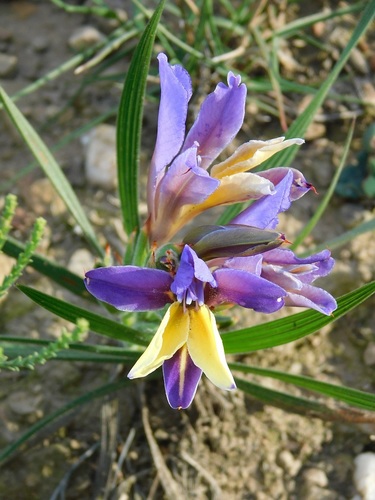
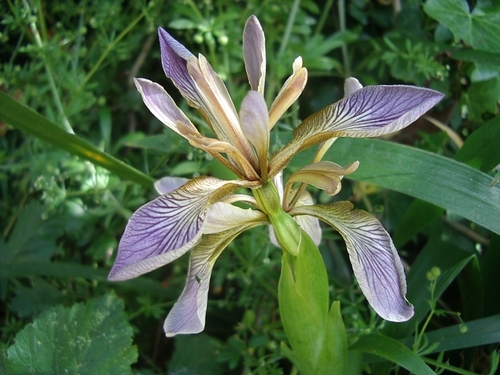
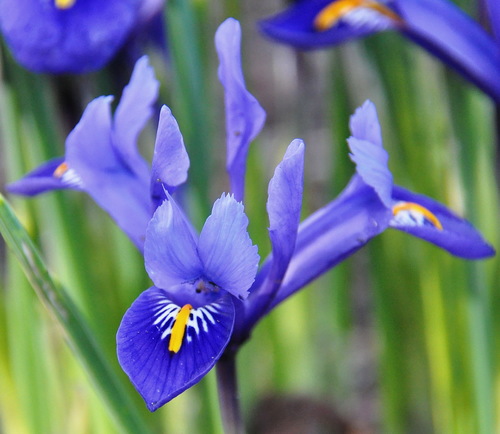
The reticulata group of irises is characterized by a fibrous net surrounding the bulb. These are small plants reaching up to 15 centimetres (5.9 in) tall, with tubular, sharply-pointed, ribbed leaves. Their flowers, which appear in early spring, are yellow, blue or purple with an orange blaze on the falls. They are hardy, but prefer a well-drained sunny position in soil that dries out in summer, so they are suitable for rock or gravel gardens. Iris reticulata has spherical to drop-shaped bulbs coated with a solid brown fibrous network. Leaves appear after flowering, and the plant has 10 cm (3.9 in) high stems. In the Northern Hemisphere, it blooms in winter between November and January, or sometimes in February. Flowers are around 2.5–3 cm (0.98–1.18 in) wide, much smaller than flowers of other irises. Like other irises, it has two types of tepals: three large outer sepals called "falls", and three smaller inner petals called "standards". Flower color ranges in shades of blue from clear blue to dark blue and purple, and the falls have a bright yellow ridge or orange mark. Iris reticulata is native to temperate areas of western Asia from eastern Turkey to Iran, and is widely cultivated in temperate regions. It is found in Hyrcanian woods along the southern coast of the Caspian Sea from Azerbaijan to Iran, growing in the mountains along the Caspian Sea. Like many other irises, most parts of the plant (rhizome and leaves) are poisonous. Mistaken ingestion can cause stomach pains and vomiting, and handling the plant may cause skin irritation or an allergic reaction. In cultivation, it prefers to grow in sunny sites on rocky soils that dry out completely in summer. It is not very hardy, but can withstand strong frosts of short duration. It is thought to be best grown in a bulb frame or alpine house in the UK and America to keep soils dry, and it needs a dry summer dormancy of several months. A specimen of Iris hyrcana won the Farrer Medal at the AGS Caerleon Show in South Wales, shown by Bob and Rannveig Wallis. The cultivars 'George' (purple), 'Katharine Hodgkin' (pale blue), and 'Pixie' (deep blue) have received the Royal Horticultural Society's Award of Garden Merit. There is a known variety called Iris reticulata var. bakeriana, which is also known as Iris bakeriana.