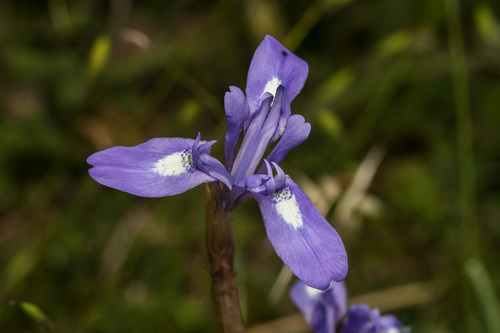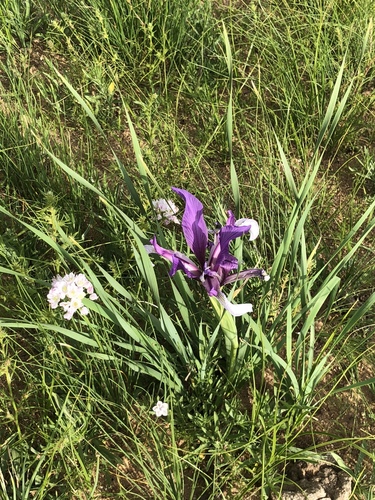
About Iris reichenbachii Heuff.
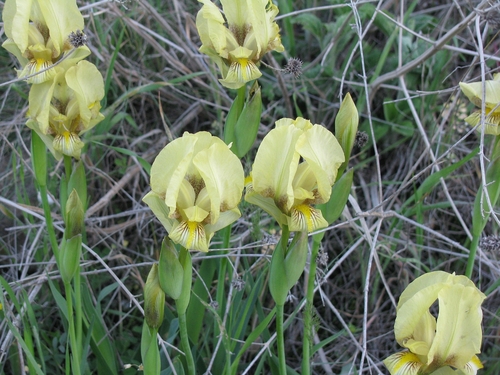
Iris reichenbachii Heuff. is a perennial bearded iris species. It is native to parts of the Balkans and northeast Greece, and is sometimes commonly called the 'Rock iris' in Romania. It is a Balkan endemic species, with a native distribution covering Albania, Bulgaria, Greece (including the Eastern Aegean islands), Serbia, North Macedonia, Bosnia and Herzegovina, Croatia, and Slovenia. It has considerable adaptability to a wide range of habitats and elevations across its range. In Bulgaria, where the species has been extensively studied, it is widely distributed across multiple floristic regions. It has been found in diverse environments, from Black Sea coastal areas and the Danubian plains to the mountainous Balkan Range, Rhodope Mountains, and other highland areas, with especially large, healthy populations located in central and western Bulgaria. Its vertical range is broad, stretching from lowland areas up to high mountain zones, with recorded specimens growing at elevations as high as 2900 m above sea level. This ability to tolerate a wide range of altitudes demonstrates the species' strong ecological adaptability. Iris reichenbachii usually grows in open, sunny habitats with well-drained soil, and is most often found in rocky areas, mountain meadows, and grasslands, frequently in calcareous substrates. These hardy irises have adapted to survive the sometimes harsh conditions of their native Balkan habitats, including periods of drought and temperature extremes. In Bulgaria, the species' wide distribution is confirmed by extensive herbarium collections, which hold nearly 300 documented specimens from different regions of the country. This makes Iris reichenbachii the most widely represented species of subgenus Iris in Bulgarian herbaria. Iris reichenbachii can be propagated through conventional methods, and researchers have also developed successful in vitro propagation protocols for conservation and commercial uses. A 2015 study conducted by Jevremović and colleagues established effective micropropagation techniques that use both somatic embryogenesis and organogenesis starting from zygotic embryo cultures. The researchers isolated zygotic embryos from seeds collected in West Serbia, and cultured them on Murashige and Skoog (MS) medium supplemented with 2,4-dichlorophenoxyacetic acid (2,4-D) as the only plant growth regulator. This method successfully induced both embryogenic and organogenic growth pathways at the same time. For somatic embryogenesis, embryogenic calli that contained somatic embryos were further maintained on MS medium with added 2,4-D and kinetin. Somatic embryos germinated successfully on plant growth regulator-free medium, achieving good germination rates. For organogenesis, green nodular calli were cultured on MS medium supplemented with different growth regulators, which induced shoot formation and proliferation. Roots grew after shoots were moved to MS medium that did not contain plant growth regulators. Plants regenerated through both methods were successfully acclimatized in greenhouse conditions, with high survival rates. These plants usually flowered during the next flowering season after acclimatization. The study also noted that while most regenerated plants kept normal morphology, some plants produced through organogenesis had altered flower structures.