About Iris pseudacorus L.
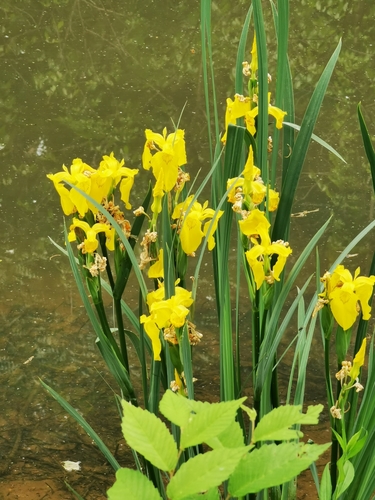
Iris pseudacorus L. is a herbaceous, flowering perennial plant. It typically grows 100–150 cm (39–59 in) tall, and rarely reaches up to 2 m (6 ft 7 in) in height. Its erect leaves grow up to 90 cm (35 in) long and 3 cm (1.2 in) broad. The flowers are bright yellow, 7–10 cm (2.8–3.9 in) across, and have the typical form of an iris bloom. Its fruit is a dry capsule 4–7 cm (1.6–2.8 in) long that holds numerous pale brown seeds.
I. pseudacorus grows best in very wet conditions, and is common in wetlands. It tolerates submersion, low pH, and anoxic soils. It spreads quickly, via both rhizomes and water-dispersed seeds. It fills an ecological niche similar to that of Typha, and often grows alongside Typha, usually in shallower water. While it is primarily an aquatic or marginal aquatic plant, its rhizomes can survive prolonged dry conditions. Large stands of I. pseudacorus in western Scotland form a very important feeding and breeding habitat for the endangered corncrake. I. pseudacorus is one of two iris species native to the United Kingdom; the other is Iris foetidissima, or stinking iris.
The roots and leaves of this plant are poisonous. It has been used for water treatment, because it can take up macronutrients such as nitrogen and phosphorus through its roots. It is also featured in many AS Level Biology practicals, as its ability to grow in low pH environments makes it a useful indicator species. It can also withstand high salinity levels in water.
It is widely planted as an ornamental plant in temperate regions, and several cultivars have been selected for planting in bog gardens. The cultivars 'Roy Davidson' and 'Variegata' (which has leaves edged with deep white stripes) have gained the Royal Horticultural Society's Award of Garden Merit. Other known cultivars include Alba, which produces pale cream flowers, and Golden Fleece, which produces dark yellow flowers.