About Iris potaninii Maxim.
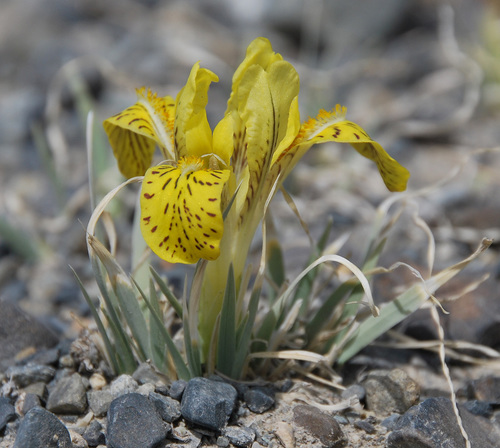
Iris potaninii Maxim. is morphologically similar to Iris tigridia (of section Pseudoregalia) and Iris bloudowii (of section Psammiris). It differs from I. bloudowii by having an ob-conical rather than prostrate rhizome, and differs from I. tigridia by retaining old leaf fibres on its rhizome and having distinct leaf form. I. potaninii has obtuse, rounded leaves that do not end in a sharp point. It has thick, short, tough rhizomes, with thick, fleshy yellowish secondary roots growing beneath them. Curled fibrous remains of the previous season's leaves sit on top of the rhizome. Its linear basal leaves (growing from the rhizome base) are obtuse (not pointed) at the tips. At bloom time, leaves measure 4–18 cm long and 0.2–0.4 cm wide; leaves lengthen after blooming, reaching up to 20 cm long and 0.3–0.4 cm wide once seed capsules form. This is a dwarf plant with either subterranean, very small stems or pedicels that reach 5 to 10 cm long. The pedicel or dwarf stem holds 2 narrow, lanceolate or oblong-lanceolate scarious membranous spathes (bracts that enclose the flower bud), which are 4–4.5 cm long and 0.6 cm wide. One terminal flower grows at the top of the stem or pedicel, blooming between April and May in Russia, or between May and June elsewhere. Flowers are 3.5–5 cm in diameter, and can be yellow, or range in shade from dark violet to purplish blue. Like other irises, it has 2 pairs of petals: 3 large outer sepals called falls, and 3 smaller inner petals or tepals called standards. The falls are obovate in shape, with markings or veins surrounding a central yellowish or whitish beard. They measure 3–4 cm long and 1.2–1.5 cm wide, and have curled edges. The erect standards are oblanceolate, 2.5–3 cm long and 0.8–1.0 cm wide, and also have curled edges. It has a thread-like perianth tube 1.5–3.7 cm long, 1.5 cm long stamens, purple anthers, and a 0.7 cm long spindle-shaped ovary. Its style branches are 2.8 cm long and 6 mm wide, with a flat crest and toothed edges. After flowering, between June and July in Russia, or between July and September elsewhere, it produces an ellipsoid seed capsule 2.5–3 cm long and 1.3–1.5 cm wide. The capsule has 6 longitudinal ribs and a short beak appendage at its top, and splits open starting from the middle of the capsule. The seeds inside are 3 mm in diameter, flattened globular or pear-shaped (pyriform), wrinkled, and reddish brown. Iris potaninii is native to temperate regions of Asia. It is found in the Russian Federation, specifically Siberia, in the regions of Aga Buryat, Buryatia, Chita (including Dahuria or Transbaikal), and Gorno-Altai. It also occurs in China in the provinces of Gansu, Qinghai, Sichuan and Xizang. It is also thought to occur in Mongolia and Tibet. It grows on rocky, gravelly, or stony slopes, and on dry mountain hillsides, at altitudes between 3,200 and 5,000 metres above sea level. It is hardy enough to survive winters in St. Petersburg, Russia without shelter, and is hardy in sheltered locations in the UK. It prefers to grow in sunny positions in well-drained soils. It has been cultivated in various Russian botanical gardens in Barnaul, Chita, and St. Petersburg since 1992, and can be grown in garden settings such as rock gardens or mixed borders. Iris potaninii has been used in traditional Mongolian herbal medicine to treat a range of conditions including bacterial infections, cancers, and inflammations. Benzoquinones isolated from the rhizomes of some Iris species are used as anti-cancer agents in modern Chinese medicine.