About Iris planifolia (Mill.) T.Durand & Schinz
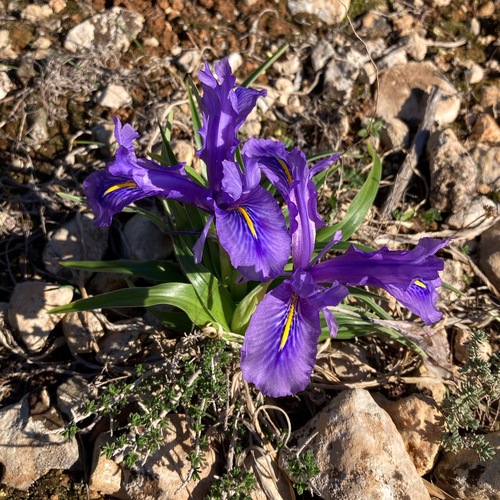
Iris planifolia (Mill.) T.Durand & Schinz grows from a large brown ovoid bulb, about 2 inches (51 mm) in diameter, with fleshy, cylindrical white roots. Its shiny green leaves are lanceolate, starting narrow at soil level and tapering to a point; they reach 10–30 cm (3.9–11.8 in) long and 1–3 cm wide, and often hide the plant's short stem when it flowers. This species is considered to have some of the largest flowers within subgenus Scorpiris. It can start flowering as early as December, January, or February, and wild specimens have been recorded flowering as late as autumn. The flowers have a light, spicy scent. It is a short, stout plant that produces up to three large flowers per stem. Individual flowers are generally 6–7 cm in diameter, with an 8–18 cm long perianth tube. The falls measure 5–8 cm long, while the standards are 2 cm long. The whole plant reaches a maximum height of 10–15 cm (3.9–5.9 in). Flowers come in various shades of blue, including bluish violet, bright sky blue, and lilac blue; occasionally, white-flowered forms occur in the wild. Like other irises, it has two pairs of petals: three large outer sepals called falls, and three smaller inner petals (or tepals) called standards. The falls have dark blue veining and a yellow crest on the ridge, and no beard. Iris planifolia produces tiny football-shaped pollen covered in small spikes. Its seed capsule is oblong and sessile, sitting at soil level in the center of the leaves, similar to the capsule of Colchicum. Its brown seeds can grow as large as a pea. It is native to Mediterranean regions of Europe and North Africa, and it is the only species in the Juno subgenus (also called subgenus Scorpiris) that occurs in Europe. Its range includes Crete, Greece, Sicily, Spain, Portugal, and Sardinia in Europe, and Algeria, Libya, Tunisia, and Morocco in North Africa. White-flowered forms of this iris are found in Andalucia. It grows naturally on rocky hillsides that are typically wet in winter and dry in summer. It is hardy to USDA Zone 3. The bulb is short-lived. In the United Kingdom, it grows best when cultivated in a bulb frame, planted in the ground rather than in pots, though it can also be grown in pots. If grown in pots, the containers must be at least 30 cm (1 ft) tall to give the fleshy roots enough space to grow. The plant needs good ventilation to prevent disease, but it is still prone to virus infections that cause stunted growth and pale or streaky foliage. Infected plants should be destroyed to prevent the virus from spreading to other plants. To support good growth in the following year, the plant prefers a warm, dry summer ripening period and sharply drained soil. It can be propagated naturally through the formation of bulb clumps. Clumps can be divided by carefully teasing the bulbs apart in late summer, taking great care not to damage the fleshy roots.