About Iris pallida Lam.
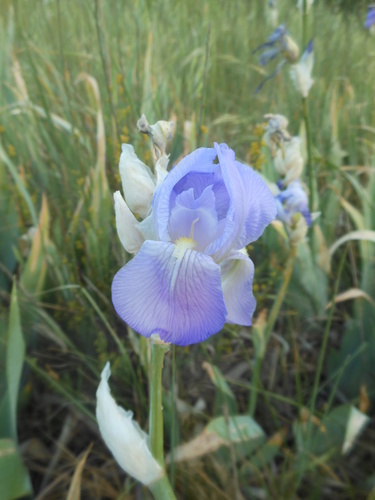
This species, scientifically called Iris pallida Lam., is an iris that favours rocky habitats in the Mediterranean and Submediterranean zone. In the southern part of its range in Montenegro, it can sometimes grow into montane regions. Its stem reaches a height of 50 to 80 cm (20 to 31 in). It has bluish-green, sword-shaped leaves that are 40 to 50 cm (16 to 20 in) long and 2.5 to 3 cm (0.98 to 1.18 in) wide. The fan-shaped inflorescence is produced in May or June, and holds two or three flowers that are usually pale purplish to whitish. Iris pallida is cultivated in the Chianti region of Italy for its fragrance and medicinal properties. It is grown as a garden plant, and also grown commercially to extract essential oils from its rhizome, which is known as orris root. This essential oil (orris oil) has historically been used for medicinal purposes, and is currently used to add flavour and scent to foods, gins, and perfumes. This species can be cultivated successfully in part because it thrives in a range of different environments, including varied climates and nutrient-poor soils. Its growth and flowering change depending on temperature. Iris pallida flowers last longer than flowers of other Iris species, but take longer to develop, particularly in colder climates. The variegated cultivar 'Variegata' has received the Royal Horticultural Society's Award of Garden Merit. For hundreds of years, Iris pallida has been used medicinally. Today, it is used to flavour foods and drinks, and to add scent to perfumes or air fresheners. This scented use dates back to the 15th century, when orris was used to give fresh scents to linens. The plant's rhizomes are also used to make beads for children's teething necklaces, as well as for rosary beads.