About Iris palaestina (Baker) Barbey
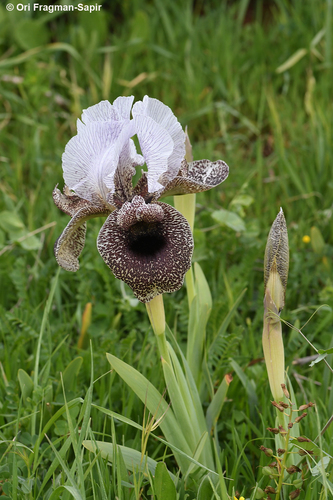
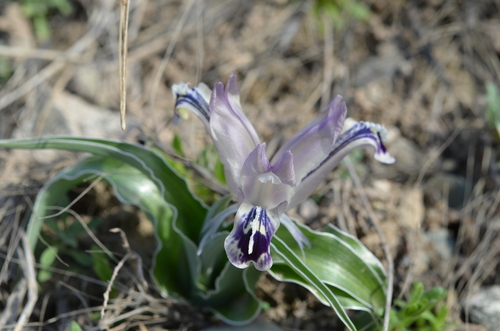
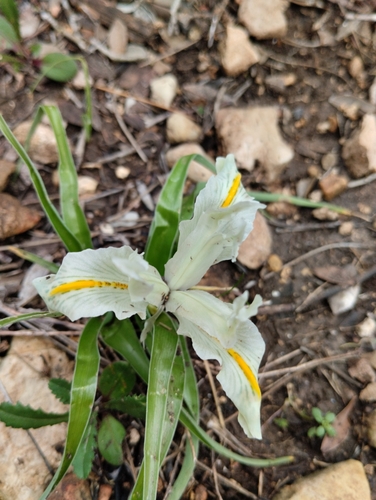
Iris palaestina (Baker) Barbey (also sometimes written as Iris palestina) produces ovoid brown bulbs measuring 25–38 mm (1–1.5 in) across. Most individual plants grow up to six leaves, which reach 150 mm (6 in) tall when the plant flowers. The leaves are typically 1–2 cm (0.39–0.79 in) wide at the plant base, are long, narrow, and strap-shaped, with wavy edges and a thin white margin. They are generally shiny green, with a glossy texture on the upper surface. This species has a short stem that grows 10–20 cm (3.9–7.9 in) high, and bears fragrant flowers between January and February. Each stem usually holds one to three flowers. The flower color is most often greenish-grey or white, and can also be yellow-white; some specimens found in southern Israel have a faint blue tinge. The flowers have winged falls, and a perianth tube 8–18 cm (3.1–7.1 in) long. This species produces oblong seed capsules, and its seeds do not have arils. This iris is native to Syria, Lebanon, and the Palestine region, which includes Israel, Palestine, and Jordan. In Lebanon, it grows in the Batha area, while in Israel it has been recorded in Golan, Galilee, the Mediterranean coast, the northern valleys, Carmel, Samarian mountains, Samarian desert, Judean mountains, Sharon, and Shefela. It prefers open stony soils containing sandstone, at low altitudes. It is most commonly found at coastal sites, but is also common within olive groves. This species is hardy to USDA Zone 4. In the United Kingdom, it is not hardy and generally grows poorly. It grows best when potted and kept under cover in a greenhouse or bulb frame. It should be planted in well-drained, fertile compost, and requires a dry rest period without watering over the summer. It can be viewed growing at the Tel Aviv University Botanic Garden. In the Middle East, it has been used as a medicinal plant to treat urinary tract infections; users boil its leaves or rhizomes in water for this purpose, in a practice similar to the traditional use of Iris pallida.